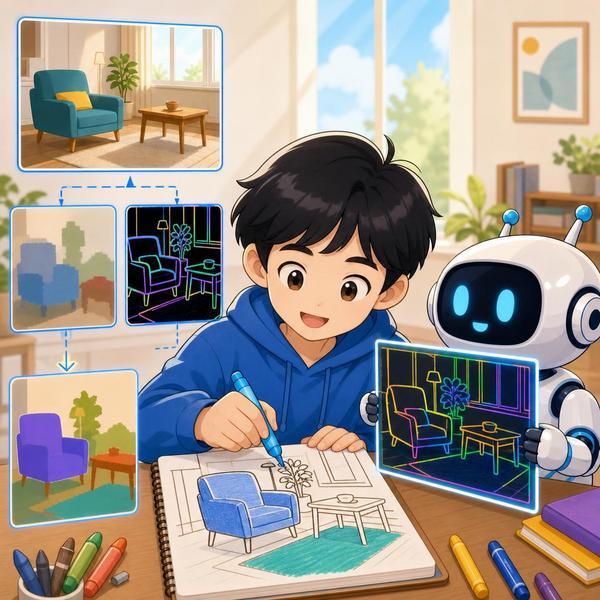
Ant Group’s Robbyant has open-sourced LingBot-Vision, a 1B boundary-centric vision foundation model for dense spatial perception, and it is made for tasks where small visual details really matter. Instead of only learning what is in an image, this model focuses on edges, contours, and depth changes, which helps robots and other AI systems understand space more clearly. The project includes Apache-2.0 model weights in four sizes, a paper, and inference code, and its results show that a smaller model can compete with or even beat much larger systems like DINOv3 on depth and segmentation tasks.
Home: Why LingBot-Vision Feels Different From Regular Vision Models
- Most vision models are trained like a student who looks at a photo and only answers, “There is a cat, a chair, and a window.”
- That sounds useful, but it misses an important point, because a robot does not just need to know that a chair exists.
- It also needs to know exactly where the chair starts, where it ends, and how far it is from the floor.
- That is where LingBot-Vision changes the game, because it treats boundaries as a first-class learning signal.
- In simple words, it pays close attention to the lines and shape changes that tell us one object is separate from another.
- You can think of it like drawing with a coloring book.
- If the outlines are clear, coloring inside the shape is easy.
- If the outlines are blurry, everything gets messy fast.
- LingBot-Vision is built to understand those outlines from the start, not as an afterthought.
- The main model, ViT-g/16, has about 1.1 billion parameters, which is large, but still much smaller than some competing models it is compared against.
- What makes this even more interesting is that it was trained on about 161 million selected images, which is far less than the giant data pools used by some rival systems.
- So this is not just a story about making a big model.
- It is also a story about training smarter.
- Robbyant released the weights in four sizes: giant, large, base, and small.
- That matters for real users, because not everyone has a giant server room or expensive GPU setup.
- A researcher may want the biggest version for the best possible results.
- A developer making a lightweight robotics demo may prefer the smaller one to save memory and cost.
- This flexible release makes the project easier to use in real life, not just in research papers.
- Another big point is that the model is self-supervised.
- That means it learned from raw images without needing humans to label millions of examples by hand.
- There were no external edge detectors used as training crutches and no older pretrained backbone used to hold it up.
- That is like learning to spot the edges of objects by looking carefully at the world, instead of copying somebody else’s notes.
- For SEO readers searching terms like “open-source vision model,” “dense spatial perception,” or “robot vision foundation model,” LingBot-Vision stands out because it solves a very practical problem.
- It is not just trying to describe images better.
- It is trying to understand space better.
- That small shift in focus is exactly why it performs so well on tasks like depth estimation, segmentation, and video tracking.
Robotics: How Boundary-Centric Learning Helps AI See Space Better
- The heart of LingBot-Vision is something called masked boundary modeling.
- The name sounds technical, but the idea is easier than it looks.
- Imagine showing a person a photo with some pieces covered up.
- If the missing part is a flat blue sky, guessing it is not too hard.
- If the missing part is the edge where a bike overlaps a road and a shadow cuts across both, now the guess becomes much harder.
- That harder part is exactly where the useful spatial information lives.
- Regular masked image training often hides patches at random.
- LingBot-Vision says random is not enough.
- It makes sure important boundary areas are hidden and then learned more carefully.
- This process is called boundary-forcing.
- The system has a teacher model and a student model.
- The teacher is an EMA copy of the student, which means it updates smoothly over time.
- The teacher looks at the image and predicts where boundary-heavy tokens are.
- Those boundary tokens are added to the masked set, so the student is forced to recover the most meaningful parts, not just the easy ones.
- This is a smart trick, because boundaries are often the places where plain semantic meaning becomes fuzzy.
- For example, at the line between a dog and the grass, “what this is” becomes less clear than “where the separation is.”
- So LingBot-Vision gives those places a geometry target as well as a semantic one.
- That means the model learns both what it sees and how the structure is arranged.
- It is a bit like learning both the name of a country and its border on a map.
- If you only know the name, your map skills stay weak.
- If you know the border too, your understanding becomes much deeper.
- The model also uses a categorical boundary field.
- Instead of trying to predict boundary information as unstable continuous values, it turns each part into bins, like sorting answers into labeled boxes.
- Each nearby pixel stores information such as distance to a boundary and angle-related details.
- Then these values are discretized into 32 bins.
- This matters because classification is often more stable than direct regression in a teacher-student loop.
- In everyday terms, it is easier to choose which shelf a book belongs on than to place it at the exact perfect millimeter on a long floating line.
- The system also uses a Number-of-False-Alarms test, or NFA, to validate decoded segments.
- This means the teacher does not blindly trust every guessed boundary.
- It checks whether the structure looks real enough to keep.
- That is helpful because bad guesses do not get recycled into new training targets.
- As a result, the model avoids teaching itself nonsense.
- This design is especially important for robotics.
- Robots work in the physical world, where tiny edge mistakes can lead to failed grasps, bumping into objects, or poor navigation.
- If a robot sees a cup and a table as one smooth blob, that is a problem.
- If it sees the cup edge clearly, it has a much better chance of interacting safely and correctly.
Tutorials: Benchmark Results That Show Why This Open Source Release Matters
- Performance is where LingBot-Vision becomes more than an interesting idea.
- It shows strong results across several dense perception tasks using frozen features and only a simple linear layer on top.
- That is important because it means the backbone itself is doing the hard work.
- The results are not being hidden behind a super-fancy decoder.
- On NYU-Depth v2, LingBot-Vision posts an RMSE of 0.296.
- That beats DINOv3 7B at 0.309 and also edges past V-JEPA 2.1 ViT-G at 0.307.
- The impressive part is that LingBot-Vision does this with roughly 7 times fewer parameters than the 7B DINOv3 model.
- That is like a smaller car outrunning a much bigger truck on a tricky mountain road.
- On KITTI, it is the best model under 2B parameters.
- For semantic segmentation, it stays competitive with top systems.
- It is only 1.3 mIoU behind distilled DINOv3 ViT-H+ on ADE20K, matches on Cityscapes, and does better on VOC12.
- Compared with same-size DINOv2, it gains more than 4 mIoU across all three segmentation benchmarks.
- That is not a tiny bump.
- That is the kind of improvement that makes researchers stop and look twice.
- Video object segmentation is another strong area.
- LingBot-Vision reaches 70.0 J&F on DAVIS-2017 and 73.5 on YouTube-VOS.
- Those numbers are close to DINOv3 ViT-H+ and the 7B DINOv3 model.
- Even more interesting, it does this with training-free label propagation over frozen features.
- In plain language, the model’s features are stable enough that objects can be followed through video frames without special extra training for time-based motion.
- Think about tracking a red ball rolling across a room.
- If the visual feature stays steady frame after frame, the system can keep following the ball even when lighting or angle changes a bit.
- That is exactly the kind of behavior people want in robotics and smart perception systems.
- There is a trade-off, though.
- LingBot-Vision is not trying to win every single image-level recognition contest.
- On ImageNet-1K linear probing, it reaches 86.32, and on k-NN it reaches 83.39.
- That trails DINOv3-7B, which focuses more on image-level invariance.
- This trade-off actually makes sense.
- If one student practices broad object naming all day and another spends more time on shapes, borders, and spatial clues, they will not become strongest in exactly the same exam sections.
- LingBot-Vision chooses to specialize in dense spatial understanding, and its results show that the choice pays off.
- The strong results also survive distillation.
- The 0.3B ViT-L student matches the 7B DINOv3 model on NYUv2 depth, scoring 0.310 versus 0.309.
- That means the benefit is not trapped inside a giant flagship model.
- It can be passed down into a smaller version that is far easier to deploy.
- For startups, labs, and developers, that may be one of the biggest practical wins in the whole release.
Open Source: How to Load LingBot-Vision and Start Using It
- One reason this release is exciting is that it is not just a paper with pretty charts.
- Robbyant released actual model weights under Apache-2.0, and that makes experimentation much easier.
- Developers can try the giant, large, base, or small versions depending on their hardware and speed needs.
- If you are a student, engineer, or hobby builder, this matters a lot because open access lowers the barrier to learning.
- The official setup begins with cloning the repository and preparing a Python environment.
- Here is the command flow in a clean format.
-
git clone https://github.com/robbyant/lingbot-vision.git cd lingbot-vision conda create -n lingbot-vision python=3.10 -y conda activate lingbot-vision python -m pip install -r requirements.txt python -m pip install -e . - After installation, you can load a pretrained backbone and extract patch tokens from an image.
- Below is the Python example from the release, cleaned up for readability.
-
import torch from lingbot_vision import load_pretrained_backbone, extract_patch_tokens, load_image device = "cuda" if torch.cuda.is_available() else "cpu" dtype = torch.bfloat16 if device == "cuda" else torch.float32 # Downloads model.pt from Hugging Face on first use. backbone, embed_dim = load_pretrained_backbone( variant="small", # giant | large | base | small; defaults to large device=device, dtype=dtype, ) img_norm, _, _ = load_image( "examples/example.png", size=512, patch_size=backbone.patch_size, mode="square", ) patch_tokens, patch_grid = extract_patch_tokens(backbone, img_norm, device, dtype) print(patch_tokens.shape, patch_grid, embed_dim) # torch.Size([1, 1024, 384]) (32, 32) 384 - This code does a few simple but important things.
- First, it checks whether a GPU is available and chooses the right device.
- Next, it loads one model variant, such as the small version.
- Then it reads an image, resizes it, and turns it into normalized input for the model.
- Finally, it extracts patch tokens, which are dense visual features spread across the image grid.
- If you are new to patch tokens, imagine cutting an image into many small tiles.
- The model gives each tile a feature vector that describes what is happening there.
- When those vectors are strong, tasks like depth estimation or segmentation become easier because the model already understands how nearby regions connect and separate.
- The output shape in the example is torch.Size([1, 1024, 384]), which means one image, 1024 patch positions, and 384 feature values per patch.
- The patch grid is 32 by 32, so the image has been split into a tidy square map of visual tokens.
- This is very useful for dense spatial tasks.
- If you wanted to build a simple classroom demo, you could run an image through the model and color similar patches to see how the system groups visual structure.
- If you wanted to build a robotics prototype, you could use those features to guide segmentation or depth completion.
- The requirements are also pretty clear: Python 3.10 or higher and PyTorch 2.0 or higher.
- A GPU is recommended for larger backbones, which is expected for modern vision models.
- Still, the presence of smaller versions means more people can test the project without extreme hardware.
- That is one of the biggest strengths of this open-source release.
- It invites people not just to read about the model, but to actually touch it and build with it.
Newsletter: What LingBot-Depth 2.0 Tells Us About Real-World Impact
- The most convincing proof of a vision backbone is often what happens downstream.
- That is why LingBot-Depth 2.0 is such an important part of this story.
- It shows what happens when LingBot-Vision is used as the starting encoder for depth completion.
- The core masked-depth-modeling recipe stayed the same as version 1.0.
- Only two ingredients changed.
- First, the encoder switched from DINOv2 to LingBot-Vision.
- Second, the training data grew from 3 million samples to 150 million.
- Those two changes led to top results across 14 depth-completion benchmarks.
- That is a big signal that the backbone is not just academically interesting.
- It is practically valuable.
- On block-masked DIODE-Indoor, the RMSE dropped from 0.132 to 0.062.
- That is close to cutting the error in half.
- If you imagine a blurry ruler becoming much sharper, that gives a rough sense of why this matters.
- For machines that need to judge distance, such gains can change whether a system works smoothly or fails often.
- The system also shines on ClearGrasp, a dataset with transparent objects.
- Transparent surfaces are famously difficult for active depth sensing systems.
- Glass, clear plastic, and shiny materials often confuse sensors because the reflected signal behaves in odd ways.
- LingBot-Depth 2.0 reaches 0.010 and 0.012 RMSE on ClearGrasp captures, which is a strong result in a tricky setting.
- This is the kind of improvement that matters in warehouses, homes, labs, and factories where robots meet reflective or see-through objects.
- A robot that cannot judge the shape of a clear bottle may grab the air next to it.
- A robot with stronger spatial features has a better chance of understanding what is really there.
- One of the most interesting findings is how the better encoder and more data work together.
- Sometimes people think more data alone will fix everything.
- But the report suggests something more subtle.
- With DINOv2 initialization, performance starts to level off after around 20 million samples.
- With LingBot-Vision initialization, performance keeps improving as the data grows toward 150 million.
- That means the stronger starting representation helps the model keep learning instead of plateauing early.
- It is like two runners training with a coach.
- One runner improves quickly and then stalls.
- The other has better technique from the start, so each extra week of practice keeps paying off.
- That second pattern is what makes LingBot-Vision especially exciting for long-term systems.
- It suggests the model is not just good now.
- It may become even more useful as people scale it into bigger pipelines and larger datasets.
- For readers following the fast-moving AI field, this is worth paying attention to.
- Many models look impressive in isolated tests.
- Fewer models show a clear path from foundation training to better real-world downstream outcomes.
- LingBot-Vision does exactly that, and LingBot-Depth 2.0 is one of the strongest signs yet that boundary-centric learning may become a bigger trend in embodied AI and dense perception.
Conclusion
LingBot-Vision stands out because it learns from boundaries, not just object names, and that makes it especially strong for dense spatial perception. Its masked boundary modeling approach helps it understand edges, contours, and depth changes in a way that is useful for robotics, segmentation, video tracking, and depth estimation. The benchmark results are strong, the open-source release is practical, and LingBot-Depth 2.0 shows that the backbone delivers real downstream value. In short, Robbyant’s release is a strong example of how smarter visual pretraining can beat bigger models on tasks where spatial detail matters most.
