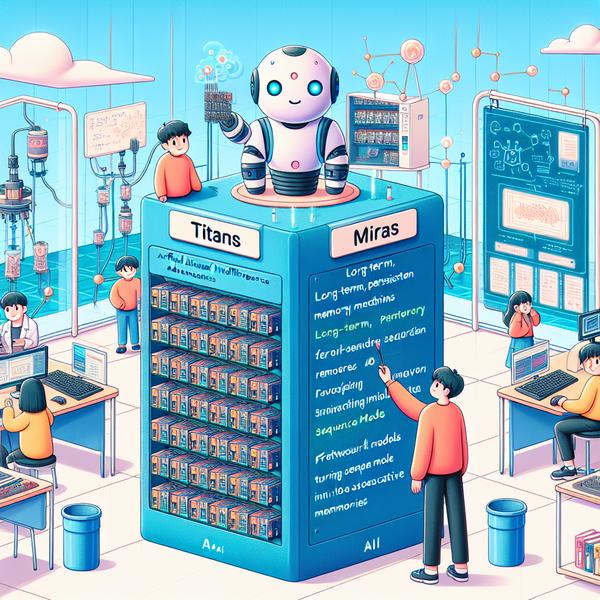
In the world of artificial intelligence advancements, Google Research has taken a significant leap with Titans and MIRAS to tackle the challenge of long context modeling in sequence models. By introducing Titans, a deep neural memory architecture blended with the Transformer style, and MIRAS, a framework turning sequence models into associative memories, this research aims to overcome the limitations of traditional Transformers. With a focus on efficiency, parallel training, and exceptional performance in handling sequences beyond millions of tokens, these innovations could redefine how we use AI models for real-world applications like language processing and reasoning. Let’s dive deeper into what makes Titans and MIRAS so groundbreaking.
Understanding Titans: Beyond Transformers
- Titans take a transformative step by adding deep neural long-term memory to the Transformer framework. While Transformers rely on attention for short-term memory, Titans introduce a persistent memory mechanism.
- Imagine you’re studying for a test. Transformers operate like sticky notes with limited space, handling only recent facts, whereas Titans are like filing cabinets where today’s study is stored for the long haul.
- This long-term memory is updated in real-time based on surprising or unexpected information, ensuring that critical details from tasks like genomic analysis or extreme data retrieval don’t get lost.
- Its architecture incorporates a multi-layer perceptron (MLP) as its memory module instead of simple vectors, enabling it to intelligently compress and retrieve historical data.
MIRAS: A New Framework for Associative Memory
- MIRAS redefines how sequence models work by viewing them as associative memories that link inputs (keys) to relevant outputs (values) while managing learning and forgetting over time.
- This framework takes inspiration from how humans recall—like connecting a familiar smell with a memory—and applies it to machine learning using design elements like attention biases and optimization rules.
- Say you’re trying to recall the name of a movie star while watching an old film with friends. MIRAS optimizes this "memory retrieval" process by teaching AI how to balance new learning and retaining old facts efficiently.
- Through methods like gradient descent with momentum, MIRAS implements gates that act like “filters,” letting the AI decide what’s worth remembering and what can be skipped.
Titans' Key Contributions to Real-World Tasks
- The ability of Titans to process context lengths beyond 2,000,000 tokens while maintaining accuracy makes it a strong competitor to larger models like GPTs.
- In benchmarks such as C4 and HellaSwag for language modeling, Titans showed better results than current cutting-edge models of comparable sizes.
- Picture an encyclopedia packed with millions of articles. Titans can fetch and combine fragments of texts scattered across volumes faster and more accurately than older technologies.
- Its hybrid approach with sliding window attention also maintains impressive performance while being efficient enough for real-world training.
How MIRAS Introduces New Variants: Moneta, Yaad, Memora
- By generalizing principles of “associative memory,” MIRAS has birthed models like Moneta, Yaad, and Memora to tackle more specific tasks.
- For example, Moneta uses clever algorithms that detect surprising patterns in data, while Yaad can robustly forget less useful data and Memora focus on recall-driven operations.
- Think of them as specialized tools in a toolbox—Moneta might be your precision screwdriver, while Yaad handles everyday tightening and Memora is designed for rare complex fixes.
- These new models go beyond traditional attention by introducing advanced mechanisms like convolutional layers and unique gating logic for parallel efficiency.
Why Titans and MIRAS Matter for AI Advancements
- Traditional Transformers hit a wall when handling extremely long contexts, affecting industries like genomics or financial modeling. Titans and MIRAS solve this scalability issue by introducing durable long-term memory.
- These innovations reduce resource usage by efficiently compressing older information without sacrificing accuracy. It’s like being able to replace a stack of floppy disks with a tiny USB that holds even more data.
- They also scale down costs while increasing versatility, making advanced AI modeling accessible to smaller research groups and companies, democratizing AI developments worldwide.
- For consumers, this shift means better virtual assistants, smarter recommendation algorithms in e-commerce, and even improved AI for medical diagnostics—all faster and more affordable than ever before.
