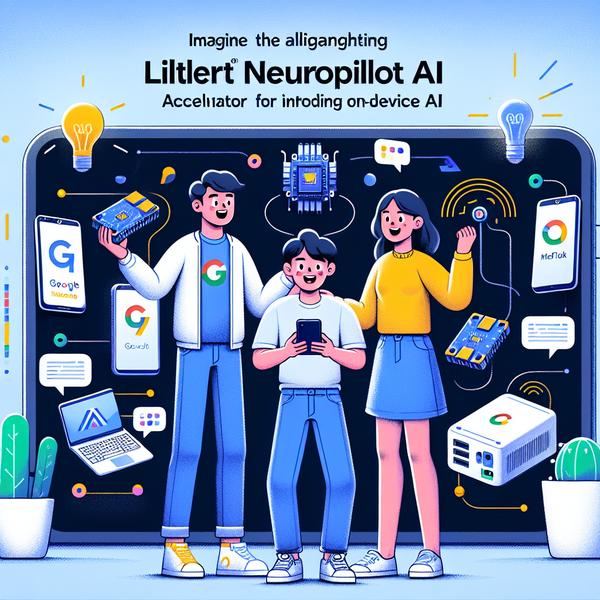
Google and MediaTek have teamed up to bring LiteRT NeuroPilot Accelerator, a game-changing advancement for on-device AI. This innovation empowers everyday devices like phones, laptops, and IoT hardware to handle complex AI tasks locally, eliminating the need to send requests to a server. It's like giving your smartphone the superpowers of a data center! Designed to work seamlessly with MediaTek's NeuroPilot NPU stack, this solution simplifies the process for developers by offering a single, unified workflow. With support for powerful models like Qwen3 and Gemma, this technology is a peek into the future of faster, smarter, and more efficient AI.
What Makes LiteRT NeuroPilot Accelerator a Game Changer?
- LiteRT NeuroPilot Accelerator, taking the mantle from TensorFlow Lite, introduces a unified high-performance runtime that supports different hardware, such as CPUs, GPUs, and now NPUs. Imagine it as a universal remote control that simplifies operations across various devices.
- This system integrates directly with MediaTek's NeuroPilot technology instead of using separate tools for each type of device chip. Think of it as having one universal tool instead of dozens of specialized ones, saving time and effort for developers.
- Supporting MediaTek's Dimensity chips like the 7300, 8300, 9000, and beyond means this innovation can power flagship Android devices, improving speed and efficiency in mobile technology.
- By replacing outdated delegations with a new Compiled Model API, developers can choose between two compilation methods: AOT (Ahead of Time) or on-device compilation. For example, larger models can be precompiled to save time, while smaller models can be compiled on the go for versatility.
- Ultimately, this means easy deployment of AI models like Qwen3-0.6B or Gemma-3-270M with minimal technical gymnastics, revolutionizing how AI is integrated into software and devices.
How Does Unified Workflows Benefit Developers?
- In the past, creating AI-ready apps for devices meant navigating a fragmented landscape—different chips required different coding paths. It’s like trying to fit square pegs into round holes. With LiteRT NeuroPilot Accelerator's single workflow, developers can now create code that fits seamlessly across all chips.
- The workflow involves just three steps: loading a model, optionally preprocessing it, and deploying it using Play for On-Device AI (PODAI). The best part? The system automatically chooses the fastest available hardware—whether it's GPU, CPU, or NPU.
- Using a structured configuration file, developers now spend less time debugging device-specific issues. Think of it as consolidating a cluttered desktop into one organized folder.
- The ability to deliver AI Packs via AOT ensures models like Gemma-3n E2B, which might take over a minute to compile on-device, are ready to run instantly, creating a smoother experience for both developers and users.
- Structural logic that previously bogged down app development becomes a thing of the past, allowing engineers to focus more on innovation and less on rewriting code.
Meet the Models: Qwen, Gemma, and More
- This tech introduces support for groundbreaking models, such as Qwen3 0.6B for market-specific text generation and Gemma-3-270M for user-friendly tasks like sentiment analysis.
- Need multilingual capabilities? Enter Gemma-3-1B, ideal for summarization and complex reasoning. It's like having a multilingual friend who helps you write papers or articles in no time.
- Gemma-3n E2B stands out as a multimodal model, enabling real-time translation of speech, images, and text. Imagine pointing your phone at a sign in another language and instantly understanding what it says!
- EmbeddingGemma 300M takes AI a step further, enabling better searches and classifications. For instance, it can help a music streaming app recommend new tracks based on your favorite genres.
- Such capabilities make MediaTek Dimensity 9500 and Vivo X300 Pro an exciting duo, promising unmatched speeds for tasks like text generation or AI-assisted camera processing.
Developer Tools and Zero Copy Buffers
- LiteRT brings a polished C++ API designed for ease. Forget clunky, outdated methods; this API enables developers to work with clear object models like Environment and TensorBuffer.
- For high-performance video or real-time camera editing, TensorBuffer::CreateFromGlBuffer eliminates intermediate steps, saving valuable processing time. For example, instead of passing data through multiple copies, developers can use these buffers to work directly with GPU memory.
- The same API supports all hardware, giving flexibility and consistency. Think of it as being able to drive different cars with one key, rather than needing a unique key for each.
- A sample C++ code snippet demonstrates real-world usage, showcasing how easy it is to allocate input and output buffers, run processes, and fetch results—all on the device itself.
- Example code snippet:
- auto model = Model::CreateFromFile("model.tflite");
- auto options = Options::Create();
- options->SetHardwareAccelerators(kLiteRtHwAcceleratorNpu);
- auto compiled = CompiledModel::Create(*env, *model, *options);
- compiled->Run(input_buffers, output_buffers);
- Example code snippet:
- Whether you're working on NLP or vision-based AI workloads, LiteRT ensures fewer roadblocks and more seamless integration into various applications.
Real-World Impact: What’s in Store for Users and Industry?
- By improving how NPUs are utilized, final users experience faster, more dependable apps. It's like upgrading from a public bus to a private jet—it simply gets you there quicker.
- Industries ranging from healthcare to entertainment can benefit from reduced latency. For instance, imagine quicker analysis of medical scans or real-time game character customization based on user preferences.
- The scalability of this system for mid-range and flagship devices ensures a broader market reach. Developers no longer have to limit these advancements to premium devices, empowering affordable AI-enabled features for everyone.
- Open-weight models bring inclusivity, allowing businesses to fine-tune or develop region-specific solutions, such as sentiment analysis tools for specific languages.
- Overall, LiteRT bridges the gap between bulky AI models and resource-efficient devices, setting the stage for impressive innovation in everyday technology.
