Thinking Machines Lab has introduced a groundbreaking update with the general availability of Tinker, their advanced training API designed to make large language model fine-tuning simpler and more practical. This release is highlighted by the inclusion of the powerful Kimi K2 Thinking reasoning model, OpenAI-compatible sampling, and the cutting-edge vision capability through Qwen3-VL models. Engineers and AI enthusiasts can now enjoy seamless large-scale model customization without the complexities of distributed training infrastructures. Let’s delve deeper into the details of what makes Tinker truly revolutionary in the AI landscape.
Unlocking the Magic of Tinker API: Simplified Model Fine-Tuning
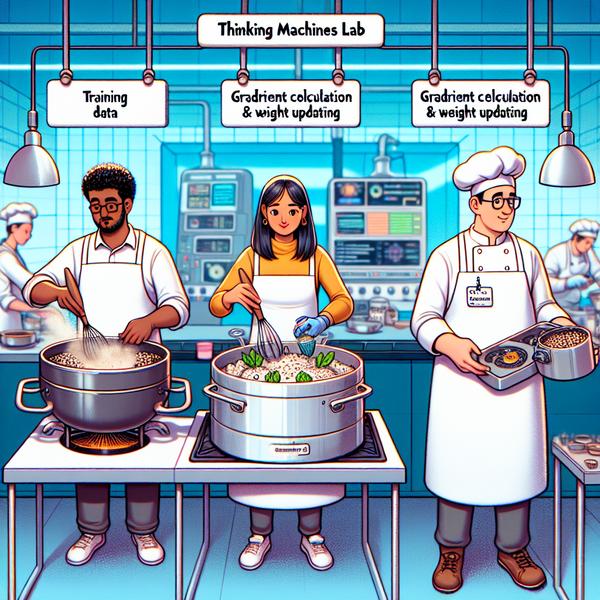
- Tinker is designed to make training large language models easier, even for those without extensive technical expertise in distributed systems. Imagine you’re baking cookies and only need to follow a simple recipe while someone else takes care of managing the ingredients, tools, and oven temperature — that’s what Tinker does for AI engineers.
- With Tinker, you write a straightforward Python loop defining the training data, loss function, and logic. The heavy lifting of mapping these computations onto multiple GPUs is handled by the platform. This means engineers can focus on crafting their "recipe" rather than worrying about the "kitchen logistics."
- The API provides easy-to-use primitives like `forward_backward` for gradient calculation and `optim_step` for weight updating. These tools are like lego blocks that users can configure to build precise training pipelines for tasks like supervised learning or reinforcement learning.
- Instead of fine-tuning complete model weights, Tinker uses LoRA (Low-Rank Adaptation), a method that trains small adapter matrices on top of existing model weights. This not only saves memory but also allows multiple experiments to run efficiently on the same cluster.
Introducing Kimi K2 Thinking: A Juggernaut for Reasoning
- Kimi K2 Thinking isn’t just another language model — it’s a reasoning powerhouse with 1 trillion parameters, making it one of the largest models in Tinker’s lineup. Think of it as assembling a dream team where each player is an expert in their field, working together to tackle complex tasks.
- This model was designed to excel in tasks requiring long chains of thought and heavy use of tools. Picture it as a “thoughtful assistant” capable of contemplating step-by-step processes before delivering answers — perfect for applications like scientific research or strategic planning.
- Engineers and researchers no longer face waitlists or restrictions to access Kimi K2. The model is now open for all users to explore and customize using cookbook examples provided in the Tinker platform.
- Other notable models include technology like Qwen3 variants for dense and multimodal features, alongside the Llama-3 and DeepSeek-V3.1 tailored for various use cases from reasoning to high-speed generation models.
OpenAI-Compatible Sampling: Bridging Simplicity and Accessibility
- The ability to easily evaluate models during training is essential, and Tinker simplifies this with OpenAI-compatible sampling. Picture yourself switching between apps on your phone with the same gestures — familiar, smooth, and quick. That’s what this compatibility accomplishes for AI developers using standard tools.
- Sampling on Tinker is intuitive — users write prompts like "The capital of France is" and fetch results with a model checkpoint URI. The outputs follow the OpenAI completions format, making it seamless to integrate fine-tuning workflows with established developer practices.
- Here’s an example in Python to understand how this looks in practice:
response = openai_client.completions.create( model="tinker://0034d8c9-0a88-52a9-b2b7-bce7cb1e6fef:train:0/sampler_weights/000080", prompt="The capital of France is", max_tokens=20, temperature=0.0, stop=["\\n"], ) - This feature invites developers who are already familiar with OpenAI tools into Tinker’s ecosystem, lowering the entry barrier and encouraging creative experimentation.
Transforming Multimodal AI with Qwen3-VL Vision Models
- What if you could ask a model to "look" at pictures and "tell" you what it sees? With Qwen3-VL models, Tinker introduces this multimodal capability to combine visual and textual inputs effortlessly.
- Two versions, Qwen3-VL-30B and Qwen3-VL-235B, offer scalability for applications ranging from simple object recognition to more complex tasks like image-based reasoning. It’s like giving the model an extra "pair of eyes."
- Feeding images and text together is straightforward. For example, constructing an input might look like this:
model_input = tinker.ModelInput(chunks=[ tinker.types.ImageChunk(data=image_data, format="png"), tinker.types.EncodedTextChunk(tokens=tokenizer.encode("What is this?")) ]) - This multimodal capability is particularly useful for real-world tasks, such as AI education tools that interpret and explain diagrams to students or e-commerce systems that analyze product photos alongside their descriptions.
Qwen3-VL vs DINOv2: A Data Efficiency Showdown
- Tinker’s team wanted to showcase the unique capabilities of Qwen3-VL models, so they put them to the test against DINOv2, a widely used vision transformer, on datasets like Stanford Cars and Oxford Flowers.
- Interestingly, Qwen3-VL-235B framed classification as a text generation task. In simple terms, the model looked at an image, thought about it, and output the name of the corresponding category as text.
- The focus was on data efficiency — starting with just one labeled example per class and gradually increasing. Qwen3-VL consistently outperformed DINOv2 as it was both better at extracting information from fewer examples and versatile across different datasets.
- The results underline the power of large vision-language models like Qwen3-VL for scenarios where labeled data is scarce but precision is a priority, such as medical diagnostics or wildlife identification.
Conclusion
Tinker is a game-changer in the AI space, streamlining large language model training with features like Kimi K2 Thinking for reasoning, OpenAI-compatible sampling, and Qwen3-VL for vision-based tasks. Whether you’re an AI researcher targeting scientific breakthroughs or a developer creating smarter apps, Tinker offers the tools to simplify, customize, and elevate your projects. Embrace this evolution and explore the world of AI with Tinker today.
