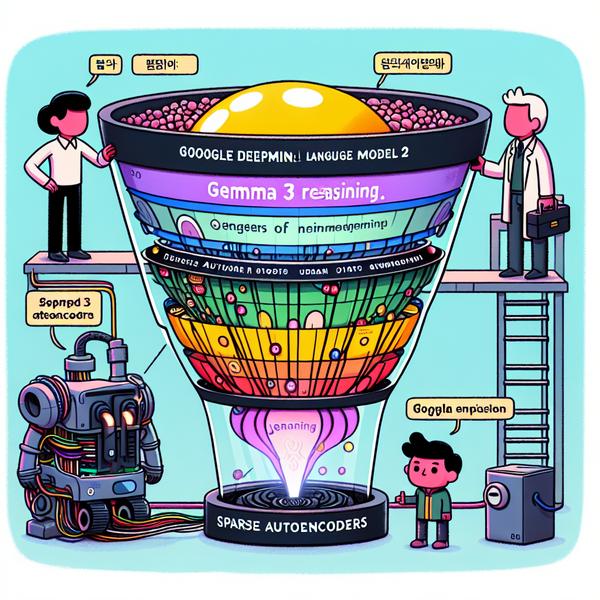
Google DeepMind has introduced Gemma Scope 2, an innovative interpretability suite designed for the Gemma 3 language models. This tool helps researchers uncover the layers of AI reasoning, from its smallest (270M) to largest (27B) models. Addressing emerging challenges like hallucinations and inexplicable decisions, Gemma Scope 2 utilizes sparse autoencoders to dive deep into the model’s internal workings. This release marks a significant development in AI safety and alignment, offering tools to track behaviors across multiple layers and scales for deeper analysis. Let’s explore the key features and advancements Gemma Scope 2 brings to the table.
What Makes Gemma Scope 2 a Game-Changer?
- Gemma Scope 2 is like a set of X-ray goggles for AI! Imagine trying to figure out how a robot solves a puzzle—this tool lets researchers see every step and decision the model makes. Unlike its predecessor, Gemma Scope 2 works on all Gemma 3 models, covering even the huge 27B parameter versions.
- It’s powered by Sparse Autoencoders (SAE), which isolate and highlight key behaviors. Think of it as peeling back layers of an onion—each layer reveals a new, smaller concept that helps researchers understand the bigger picture.
- By studying internal activations, these SAEs help us determine how the AI reaches its conclusions (or makes mistakes). For example, if an AI tells you a completely made-up fact, Gemma Scope 2 can show which step and layer contributed to this error.
- The focus is on transparency, giving safety teams a way to prevent problems like "jailbreaking" (when models bypass safeguards) or producing "hallucinated" information that isn’t actually true!
- This tool isn't just about pointing fingers at mistakes—it also helps improve and align AI behavior, setting a strong foundation for future advancements in language models.
Key Improvements Over the First Gemma Scope
- The initial Gemma Scope was great but limited to smaller models and fewer layers. Gemma Scope 2 significantly ups the game with compatibility for Gemma 3’s massive range of parameters.
- A critical enhancement is the addition of transcoders that help trace and connect calculations across multiple layers. Imagine trying to follow a maze—these transcoders are like a map that shows you every turn the model takes!
- The use of Matryoshka training subverts earlier issues by training smaller interpretable "concepts" first and stacking them, much like Russian nesting dolls. This makes it easier to understand and fix AI’s logic mistakes.
- One of the coolest upgrades? It’s now tailored for conversational AI models too! Whether the AI is helping in customer service or being chatty during a game, safety teams can see if and where communication breakdowns happen.
- These upgrades give researchers the advantage of tracing emergent behaviors—those puzzling traits that often show up only in massive models, like the 27B parameter Gemma 3. Imagine discovering new skills in AI that no one trained explicitly. This tool lets you analyze and improve those "surprises."
How the Suite Supports AI Safety
- The goal of Gemma Scope 2 isn't just about making AI smarter—it’s about making it safe and reliable. Let’s say an AI is working in healthcare, and it mistakes patient records. With Gemma Scope 2, researchers can figure out exactly where the confusion started.
- Safety mechanisms like refusal logic checks are woven into this suite. For example, if a harmful request is made, Gemma Scope 2 helps scrutinize why the AI refused—or didn’t refuse—a particular instruction.
- It also tackles human-like errors such as sycophancy (agreeing with user input regardless of accuracy). If someone says, "2+2=5," the AI shouldn’t just go along with that. Thanks to Gemma Scope 2, safety teams can catch and fix this blind agreement behavior at its core.
- Crucially, it bridges the gap between what an AI "thinks" and what it "says" by comparing its internal state to its reasoned conclusions. An AI that hides critical information or delivers incomplete responses would now be easier to evaluate and improve.
- This makes Gemma Scope not just a research tool but an important ally in shaping more responsible AI technologies for industries like education, law, and healthcare.
Big Data Challenges and Solutions in Training
- Building Gemma Scope 2 was no small feat—it required storing 110 petabytes of activation data and fitting over 1 trillion parameters across interpretability models. To visualize this, think of storing every single picture taken by humanity in a single place!
- The size of the models alone poses a challenge. The smallest has 270M parameters, while the largest has 27 billion. For context, that's like comparing a tiny city road map to a detailed atlas of the world. Both are complex, but the larger one needs much more effort to fully study.
- The training process is inspired by a Russian Matryoshka doll concept—each layer is smaller, supporting the bigger outer layers. This helps ensure stable and interpretable results across varying model sizes.
- By meticulously analyzing stored data, this tool reveals the "thought process" of AI models. For instance, when a model creates a sentence, Gemma Scope 2 shows how it shaped that sentence step by step, including where it might have gone wrong.
- This process ultimately empowers researchers with a comprehensive understanding of how a model learns and applies its knowledge, ensuring that AI safely integrates into real-world applications.
Future Implications for AI Development
- Gemma Scope 2 isn’t just a snapshot of today’s AI possibilities—it sets the stage for future advancements. Its capabilities can inspire the creation of safer, smarter, and more transparent AI systems.
- Think of self-driving cars exclusively relying on AI. Gemma Scope 2 can be used to analyze decision points, like why a car chose to brake suddenly or change lanes. This transparency builds trust between humans and machines.
- Moreover, as businesses adopt AI for customer support or personalized recommendations, they can confidently rely on tools like Gemma Scope 2 to ensure ethical and accurate algorithms.
- Now, imagine gaming worlds populated by intelligent non-player characters (NPCs). With this suite, developers can analyze scenarios and ensure these AI agents act predictively and enjoyably without frustrating users.
- As the tech evolves, businesses, educators, and researchers can work hand-in-hand, using Gemma Scope-inspired solutions to turn complex AI into a tool everyone can understand and benefit from.
