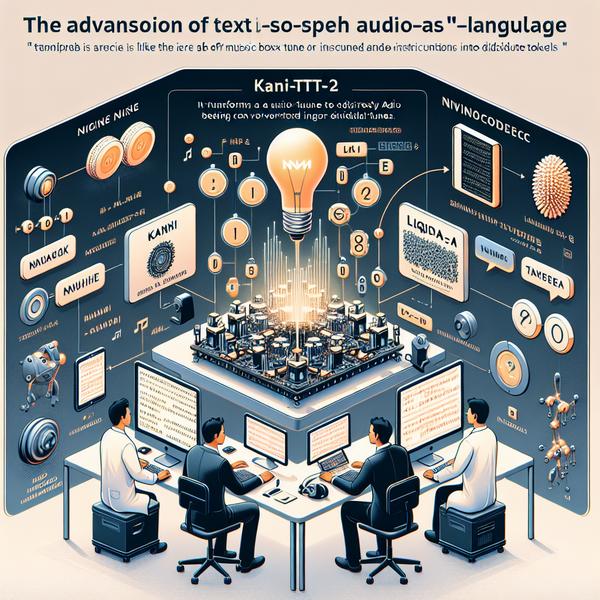
The release of Kani-TTS-2 by nineninesix.ai marks a significant advancement in text-to-speech (TTS) technology. Unlike traditional heavy and computationally expensive models, Kani-TTS-2 adopts an efficient "Audio-as-Language" philosophy. Its blend of LiquidAI’s LFM2 and NVIDIA’s NanoCodec ensures outstanding performance with a lean architecture. This 400M parameter model supports zero-shot voice cloning, operates on as little as 3GB VRAM, and generates human-like speech at lightning speed. With licenses allowing commercial use and support for both English and Portuguese, it sets a new standard for efficiency and accessibility in generative audio innovation.
Shifting the Paradigm: "Audio-as-Language" Philosophy
- Unlike older TTS systems relying on mel-spectrogram pipelines, Kani-TTS-2 processes audio as discrete tokens. This innovation mimics how texts are parsed using natural language processing.
- Imagine this as converting a piece of music box tune into instructions for individual notes, rather than interpreting an entire song all at once—that’s how Kani-TTS-2 handles audio synthesis!
- Its efficiency stems from LiquidAI’s LFM2 (350M) backbone, which operates similar to a lightning-fast mind predicting the next word—or in this case, audio token—in a sentence.
- With NVIDIA’s NanoCodec generating 22kHz waveforms, the speech output is both clear and natural, avoiding the mechanical tones typically found in older models.
Why Kani-TTS-2 Stands Out in Efficiency
- Training Kani-TTS-2 for 10,000 hours of speech data took just 6 hours using eight NVIDIA H100 GPUs. For context, this is like completing the assembly of a puzzle in hours, which usually takes weeks.
- The underlying "LFM2" ensures it processes audio tokens with minimal resources, enabling super-efficient training.
- This revolutionary approach cuts down time, making advancements more affordable for developers who may lack access to large compute clusters.
- Even on consumer-grade GPUs like the RTX 3060, the model runs smoothly while maintaining high fidelity—perfect for edge deployments!
Zero-Shot Voice Cloning: Redefining Possibilities
- Kani-TTS-2 takes personalization to a new level with its zero-shot voice cloning ability. Simply provide a short reference clip, and the model mimics the unique voice perfectly.
- Think of it as a voice impressionist that can not only mimic a celebrity’s tone instantly but also use that tone to deliver any text you want.
- This capability eliminates the old approach of hours-long fine-tuning—bringing both speed and convenience to developers.
- For applications like AI-driven assistants or dubbing, the functionality opens doors to creating more lifelike and diverse voices efficiently.
Bringing AI Innovation to Your Hardware
- You don’t need an expensive data center setup to use Kani-TTS-2. Thanks to its compact 3GB VRAM requirement, even standard consumer GPUs like the RTX 4050 can handle it seamlessly.
- The real-time factor (RTF) of 0.2 means 10 seconds of audio generation takes just about 2 seconds—nearly instantaneous for real-world workflows.
- This is like having a high-performance car engine that can run on regular fuel, ensuring accessibility for both enthusiasts and enterprises.
The Open-Source Advantage with Kani-TTS-2
- Being released under the Apache 2.0 license, Kani-TTS-2 allows you to access and even modify its framework for your unique needs, whether commercial or personal.
- Imagine being given a treasure map to endless possibilities—it’s customizable and completely under your control.
- The availability on Hugging Face hub in both English and Portuguese [EN, PT] ensures you can kickstart projects without being bogged down by proprietary restrictions.
Conclusion
Kani-TTS-2 exemplifies a leap forward in text-to-speech technology by combining efficiency, accessibility, and high-quality audio synthesis. Its open-source design, low resource requirements, and innovative features like zero-shot voice cloning make it a game-changer. Whether you're a hobbyist working with consumer-grade hardware or an enterprise seeking scalable solutions, this model is well-positioned to support diverse applications.https://www.marktechpost.com/2026/02/15/meet-kani-tts-2-a-400m-param-open-source-text-to-speech-model-that-runs-in-3gb-vram-with-voice-cloning-support/
