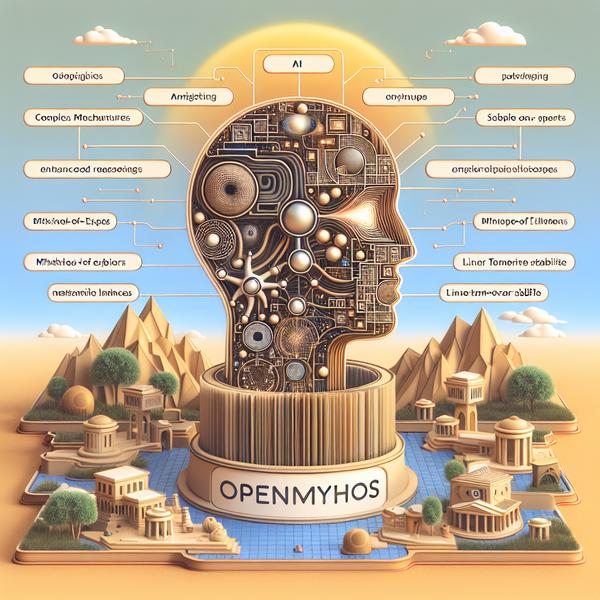
OpenMythos is a groundbreaking open-source initiative that reverse-engineers the structure of Claude Mythos using PyTorch, without relying on leaked models or proprietary data. The focus is on exploring the innovative Recurrent-Depth Transformer (RDT) architecture, which uses looping mechanisms for enhanced reasoning. The model optimizes parameter efficiency, enabling a 770M parameter RDT to rival the accuracy of a 1.3B parameter standard transformer. With well-thought-out features like Mixture-of-Experts (MoE) layers and Linear Time-Invariant stability, OpenMythos demonstrates a unique, scalable solution to complex AI tasks. This blog dives into the unique architecture, efficiency, and transformative potential of OpenMythos in pushing AI boundaries.
The Foundations of OpenMythos: Recurrent-Depth Transformers
- OpenMythos rewrites the rulebook by introducing Recurrent-Depth Transformers (RDTs). Unlike traditional transformers that process data layer by layer, these have a looping mechanism, where the same set of weights processes data multiple times in a single forward pass.
- Imagine writing an essay and reviewing the same paragraph multiple times to improve it—this is how RDTs handle data. Instead of requiring more layers, the depth of reasoning is based on the number of loops.
- This looping feature not only reduces the overall need for parameters but also ensures each pass builds on the last, improving the understanding of input.
- To simplify, it means you could use fewer tools in your toolbox but still build something just as good or better because you’re cleverly using those tools over and over again.
Why Parameter Efficiency Is a Game-Changer
- One standout feature of OpenMythos is its parameter efficiency. With just 770M parameters, it matches the performance of a traditional model with 1.3B parameters.
- Think of it as packing lighter for a trip yet being fully prepared. By applying the same weights repeatedly (looping), OpenMythos avoids redundancy and enhances computational efficiency.
- This efficiency also means it can solve problems with fewer resources, making advanced AI more accessible to teams with limited hardware.
- In simpler terms, it’s like upgrading the power of a bicycle to function like a motorized vehicle without actually adding any extra parts.
Exploring the Mixture-of-Experts (MoE) Layer
- The MoE layers in OpenMythos serve as the secret sauce. Unlike standard feedforward networks, the MoE system activates only a few specialized “experts” at a time for each token, saving computational power.
- Picture a doctor consulting with specialists for specific concerns instead of relying on a general practitioner alone for everything. That’s how MoE ensures precision and speed in solving tasks.
- Each iteration activates different subsets of these experts, making sure that every loop is computationally unique.
- This approach not only helps cover a broader range of specialized tasks but also keeps the computations lightweight—similar to delegating work to experts who are highly efficient in their specific domains.
Achieving Stability Through Advanced Engineering
- Training models with deep loops can lead to problems like residual explosions, where outputs grow uncontrollably, or “overthinking,” where extra iterations mess up the results.
- OpenMythos addresses these issues with Linear Time-Invariant (LTI) constraints and Adaptive Computation Time (ACT) stopping. These features stabilize the model and allow it to self-regulate looping depth.
- For example, imagine pouring water into cups of different sizes. The ACT ensures you stop pouring once each cup is full, preventing overflow or underfill.
- This thoughtful design ensures OpenMythos delivers efficient and accurate results while avoiding computational hiccups. It’s like driving on a well-maintained road with signs guiding you at every step.
The Bigger Picture: Continuous Latent Reasoning
- One of the model's most fascinating aspects is that it processes reasoning continuously within its latent space, unlike chain-of-thought methods that rely on intermediate text outputs.
- Think of it as pondering multiple solutions in your head before saying anything out loud; this allows for more nuanced and creative problem-solving.
- This approach is not only faster but also more flexible, allowing the model to work on reasoning problems with more depth or different angles without having to retrain.
- Because it operates efficiently in this "silent thinking" mode, OpenMythos broadens the horizon for more complex and adaptable AI capabilities—like brainstorming ideas you didn’t know your mind could handle!
