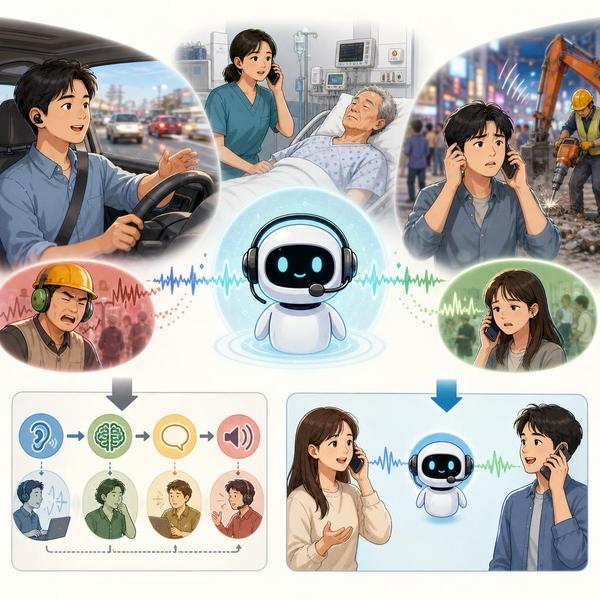
Bland has launched Tofu-1, a full-duplex speech-to-speech model for calls, and this matters because it can listen, think, and reply in real time without turning speech into text first. The model is made for hard calling situations like moving cars, hospital rooms, and weak phone lines, where normal voice systems often struggle to keep up. It also stands out because it can notice who is speaking, separate voices from loud background noise, and catch small emotional clues like stress, hesitation, or urgency. In short, Bland Tofu-1 is not just another voice bot for calls, but a new kind of Voice AI system that tries to handle conversation more like a real person.
Why Tofu-1 Changes Call Audio in Voice AI
- Tofu-1 is Bland’s first full-duplex speech-to-speech model, which means it can hear and speak at the same time during a phone call.
- That may sound simple, but it is actually a big shift from how many older voice systems work.
- Most older systems act like a chain of helpers passing notes.
- First, one part listens and turns speech into text.
- Then, another part reads that text and decides what to say.
- After that, a third part turns the answer back into sound.
- This is often called a cascade system.
- It works, but it can feel slow, stiff, and easy to confuse.
- Tofu-1 tries to skip that middle note-passing step and work directly with sound.
- That is important because real conversations are more than just words.
- When a person says “I’m fine,” the meaning can change a lot depending on tone.
- A tired voice, an angry voice, or a shaky voice can each mean something very different.
- Text alone often hides those small signals.
- By listening to raw audio instead of only a transcript, Tofu-1 keeps more of the real-life meaning.
- You can think of it like the difference between reading movie subtitles and actually hearing the actor speak.
- The words may be the same, but the feeling is not.
- This design is especially useful for phone-agent teams that need smoother and more natural call handling.
- It also helps in messy real-world places, not only quiet demo rooms.
- Bland says Tofu-1 is built for calls from moving cars, hospital rooms, and poor-signal lines.
- These are places where many AI voice tools break down because too much noise gets in the way.
- If you have ever tried talking on the phone while a TV was loud in the background, you already know how hard this can be.
- A basic system may grab the wrong voice, miss key words, or pause at the wrong time.
- Tofu-1 is meant to do better in exactly those moments.
- That goal makes the launch important not only for AI fans but also for companies that run support lines, care hotlines, insurance calls, or banking help desks.
- Instead of sounding like a robot that waits for its turn, the model aims to feel more like a person who is actively following the conversation.
How Speaker Tracking Helps in Noisy Calls
- One of the most interesting parts of Tofu-1 is its audio understanding.
- Bland highlights three main skills: speaker tracking, noise separation, and paralinguistics.
- These may sound technical, but the ideas are easy to picture in daily life.
- Speaker tracking means the model can tell different speakers apart and figure out who is talking to whom.
- Imagine a family sitting in a car.
- One person is calling a clinic, a child is asking for snacks in the back seat, and someone else is speaking to the driver.
- A weak voice bot might mix all of that together like paint in water.
- Tofu-1 is supposed to keep those voices separate and stay focused on the caller.
- That matters a lot in real phone calls because people are almost never in perfect silence.
- Noise separation is another major skill.
- This means the model tries to pull the main voice away from other sounds such as traffic, a crying child, a TV, hospital announcements, or keypad tones.
- Think of it like trying to hear your friend in a crowded school cafeteria.
- Your brain naturally tries to lock onto one voice and ignore the rest.
- Tofu-1 is being designed to do something similar with call audio.
- Then there is paralinguistics, which is a fancy word for the little clues in how people speak.
- This includes hesitation, frustration, urgency, and emotional pressure.
- For example, a customer might say, “I need help with my account,” in a calm tone.
- Another customer might say the same words quickly, with stress and panic.
- The text looks almost the same, but the feeling is completely different.
- That difference can change how a good call system should respond.
- In healthcare or emergency-related support, noticing urgency can be especially important.
- In banking, frustration may mean the user is already close to ending the call.
- In insurance, hesitation may show that the caller is confused and needs clearer steps.
- These are small details, but on live calls they can shape the whole experience.
- Bland also mentions that Tofu-1 can handle direct audio without showing a text transcript between input and output.
- That makes the model feel more like a listener than a typist.
- It is not just hearing words.
- It is hearing the whole scene around those words.
- That is a big reason why this model is getting attention in the Voice AI space.
What Full-Duplex Means for Real-Time Conversation
- The phrase full-duplex is one of the key ideas behind Tofu-1.
- In simple words, it means the model can listen while speaking instead of waiting for total silence before reacting.
- This makes a call feel more natural because real people do this all the time.
- We interrupt, correct ourselves, add details, and react while the other person is still talking.
- Older systems often work more like a walkie-talkie.
- One side talks, then stops, then the other side gets a turn.
- That style can make AI calls feel slow and clunky.
- Tofu-1 is built to reduce that problem.
- Bland says callers can interrupt or correct the model in the middle of a sentence.
- That is useful because people often remember important details late.
- For example, a caller might say, “Actually, not tomorrow, I mean next Tuesday,” before the AI has finished answering.
- A rigid model may miss that correction or restart awkwardly.
- A full-duplex model should be better at catching it right away.
- Bland also says Tofu-1 can keep the conversation moving while it works on a request.
- That means it does not have to go completely silent when it is checking something in the background.
- Imagine calling customer support and hearing total silence for ten seconds.
- Most people would wonder if the call froze.
- A smarter model can say something helpful like, “I’m checking that for you now,” while still staying engaged.
- This is a lot like a human assistant talking while using a computer.
- The assistant may say, “Give me one second, I’m pulling up your file,” instead of disappearing into silence.
- That small behavior makes the interaction feel smoother and more trustworthy.
- Bland also claims that Tofu-1 reports results only when the work is actually done and does not pretend a task is finished early.
- That point matters because rushed AI systems sometimes speak too confidently before they have completed a real backend step.
- For users, false confidence can be worse than a short wait.
- If an AI says a booking is complete when it is not, the damage can be serious.
- So “thinking while talking” should not mean “guessing while talking.”
- It should mean staying present while real work happens in the background.
- This feature could be especially strong in industries with long and detailed calls.
- Banking teams may need account checks.
- Healthcare teams may need to confirm records.
- Insurance teams may need to collect many facts during a claim.
- In all of these cases, a system that keeps speaking naturally while still listening can create a much better call experience.
What the TV Test Shows About Background Noise
- Bland’s “TV Test” is one of the easiest ways to understand what Tofu-1 is trying to solve.
- The test asks a simple question: can the model follow the real caller while ignoring speech coming from another scene, like a television?
- This is a smart test because TV sound is tricky.
- It is not random noise like wind or static.
- It is clear human speech, and sometimes it can even be louder than the caller.
- That makes it a real challenge for voice systems.
- If you have ever tried talking to someone while a news anchor was speaking loudly in the same room, you know how distracting that can be.
- A weak AI model may lock onto the wrong voice and mistake TV words for user input.
- That can break the whole call.
- The TV Test matters because it checks whether the system can stay focused on the person who actually matters.
- In real homes, background media is everywhere.
- People call from kitchens, living rooms, waiting rooms, and car seats.
- Some are near music, others near a child’s cartoon show, and others near another person having a separate conversation.
- So this is not an edge case.
- It is normal life.
- Bland notes that its TV Test example is only illustrative and not recorded model output.
- That is an important detail because it means readers should be careful not to treat it like a benchmark result.
- Still, the test idea itself is useful.
- It points to the kind of problem a good phone AI must handle if it wants to work outside clean lab settings.
- Another interesting feature tied to this is scene generation.
- Bland says that because Tofu-1 models the sound of a call, it can also produce one.
- That includes a second speaker, line noise, and the feel of the room around the call.
- In simple terms, the model is not only learning words but also learning the sound world those words live in.
- That is a little like how a good actor does not just memorize lines.
- The actor also learns the mood, timing, and setting of the scene.
- This could help the system sound more realistic in long conversations, where flat robotic delivery becomes tiring.
- It may also help the model understand more complicated call situations because it has learned to represent whole audio scenes, not only isolated phrases.
- For companies building advanced call agents, that could open the door to more lifelike and steady voice experiences across many settings.
Why Enterprise Access and Research Preview Matter
- Even though Tofu-1 sounds exciting, there are still many things we do not know.
- Bland has not shared the model size, full architecture details, pricing, or clear public benchmark numbers.
- That means people should stay curious but careful.
- Right now, Tofu-1 is in a closed enterprise research preview, not an open self-serve product.
- So regular developers cannot simply click a button and start testing it freely.
- This limited access tells us that Bland is still controlling where and how the model is used.
- The sign-up appears to focus on enterprises with serious call volume.
- Bland names banking, healthcare, insurance, and government as target sectors.
- That makes sense because those industries deal with many phone calls and often work in noisy, stressful, or sensitive situations.
- A hospital callback line is very different from a simple chatbot on a website.
- In those call-heavy sectors, small gains in speed and understanding can matter a lot.
- Still, when we compare Tofu-1 with other full-duplex systems, the picture is mixed.
- Some rivals have published more direct numbers.
- For example, OpenAI’s GPT-Live-1 lists latency figures, and NVIDIA NemotronLabs VoiceChat 11B shares details such as parameter size, open availability, and hardware support.
- By contrast, Tofu-1 keeps many technical facts private for now.
- Bland does mention one self-reported number: more than 92% of people in screenings could not spot that it was AI.
- That sounds impressive, but it should be read carefully because we do not yet have the full test setup, sample size, or public repeatability.
- It is a little like hearing that a new student is the fastest runner in school without seeing the race times.
- The claim may be true, but people will still want proof and context.
- Another useful point is that there was no Python code shared in the provided source page content.
- So there is no code block to clean up or reproduce here.
- That itself is worth noting for technical readers who may expect a demo repository or API example.
- For now, the launch is more of a product and capability announcement than a hands-on developer release.
- From an SEO and reader value point of view, the big takeaway is this: Tofu-1 is promising because it attacks one of the hardest problems in Voice AI, which is real-time natural calling in messy environments.
- But it is also early, closed, and missing several public metrics.
- That means businesses may watch it closely, while developers and researchers wait for broader access, clearer benchmarks, and deeper technical detail.
Conclusion
Tofu-1 shows how Voice AI is moving beyond simple speech recognition and into real-time conversation that feels more natural. Its biggest strengths are direct audio understanding, full-duplex interaction, noise handling, speaker tracking, and the ability to catch emotional clues during calls. At the same time, the model is still in closed enterprise research preview, so many important details like latency, architecture, pricing, and public benchmarks remain unknown. Even with those limits, Bland Tofu-1 stands out as an important step toward smarter call agents that can work in the messy, noisy places where real people actually live and talk.Source: https://www.marktechpost.com/2026/11/15/bland-tofu-1-full-duplex-speech-to-speech-model/
