Building AI-powered agents that can learn and adapt over time is a fascinating challenge. This guide lays out a framework to create a procedural memory agent, teaching it to accumulate, store, and reuse skills effectively. The process emphasizes using neural modules, state-action embeddings, and exploration to enhance efficiency. From designing an adaptable memory system to observing the agent gradually improve across multiple episodes, this approach offers clear, interpretable insights into the evolution of intelligent agent behaviors. Dive in to explore step-by-step code snippets, visualizations, and practical examples to truly understand how skill learning transforms an AI agent's capabilities over time.
Step 1: Designing the Framework - The Foundation of Procedural Memory
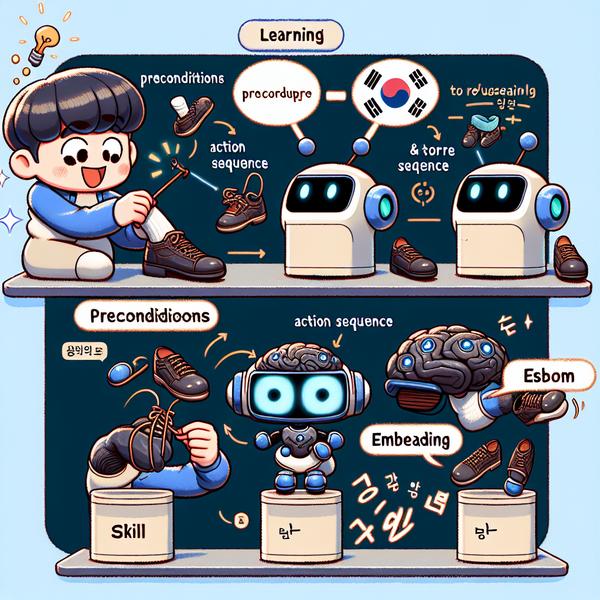
- Imagine teaching a robot how to tie a shoelace. You wouldn't explain each step every time—it would learn the sequence, store it, and use it later. That’s procedural memory in action!
- Our AI agents operate similarly. Through skill-based frameworks, their actions are structured into reusable sequences, mimicking a human's ability to remember and execute.
- The "Skill" class in the code encapsulates these key elements:
Preconditions: Defines when a skill can be used. For instance, "open_door" requires a "key".Action Sequence: The series of steps needed to complete a task.Embedding: Stores a mathematical representation of the context for comparison.
- This modular design ensures that our AI agent doesn’t just mimic actions but also learns conditions under which specific actions work best, enabling smarter responses to new environments.
Step 2: Building the Skill Library - Where Knowledge Lives
- A skill library acts like a personal toolbox, storing all the tricks an agent learns during exploration. Think of it as a chef's recipe book, organized for quick referencing.
- For our agent, the library evolves as it:
- Adds new skills—avoiding duplicates by checking cosine similarity between embeddings.
- Updates existing skills, increasing their success count to highlight relevancy.
- Skills are retrieved using a smart prioritization system. The more successful a skill or the closer its context matches the agent's current situation, the quicker it is fetched.
- For example, if the agent finds itself near a locked door and has a key, the library suggests the "open_door" skill. This adaptive retrieval enables smooth, human-like decision-making.
Step 3: Crafting the GridWorld Environment - A Learner’s Playground
- Learning is best done in a manageable, structured environment, much like kindergarten for children.
- We use a simple GridWorld, consisting of:
- A start position and a goal—representing the agent's objectives.
- Key interactive objects such as a "key" and a "door" to encourage problem-solving tasks.
- Tasks like "pickup_key" or "navigate_to_goal" granted rewards, reinforcing the system to remember what works well.
- This sandbox offers just enough complexity to observe the agent build step-by-step skills while still keeping results understandable.
- Environments like these allow beginners and experts alike to tweak, adapt, and scale AI's learning process incrementally.
Step 4: Embedding Actions - Teaching the Agent Context
- Imagine showing someone their childhood photo—something instantly recognizable due to the memories associated with it. Similarly, embeddings act as mental snapshots of action contexts for our AI.
- The agent creates embeddings by condensing:
- State data (e.g., is the agent holding a "key"?).
- Action histories (e.g., sequences of movements leading to success).
- These embeddings power the "similarity search" algorithm, helping the AI recall and reapply relevant knowledge to solve problems in new, but familiar, scenarios.
- For instance, while navigating a new building, the agent might reuse a staircase-climbing skill it learned earlier in a different environment. This flexibility is critical as it prevents starting from scratch each time.
Step 5: Training and Visualization - From Novice to Mastery
- Training an agent is like raising a child—it starts with simple trials but grows to handle increasingly complex tasks autonomously over time.
- The training process in our code involves:
- Episodes: Repeated attempts to achieve goals, with rewards or failures reinforcing certain actions.
- Evaluating skill use to favor successful and efficient solutions.
- Introducing visual summaries of progress, such as how many skills the agent has learned, average success rates, and rewards gained per episode.
- A concrete example: Early episodes see the agent wander aimlessly. With time, successful sequences like "grab_key + open_door" emerge as reusable skills, dramatically shortening task completion times.
- The visualizations bring learning to life, showing how focused practice can turn a bumbling beginner into an efficient expert.
