Have you ever wondered if an artificial intelligence system could mimic the human brain's way of organizing thoughts, memories, and connections? What if this system could link concepts, draw insights, and even “sleep” to consolidate its knowledge? At the forefront of pioneering Agentic AI, a unique project introduces the "Zettelkasten" memory system—a self-organizing, living architecture modeled after human cognition. Centered around dynamic knowledge graphs, this innovation leverages Google’s Gemini and other technologies to extract atomic facts, create semantic connections, and improve long-term context understanding. Ready to dive into the future of intelligent agents and explore how this groundbreaking framework unfolds? Let’s explore step by step how to build this revolutionary memory system.
Building Blocks of a "Living" Memory System
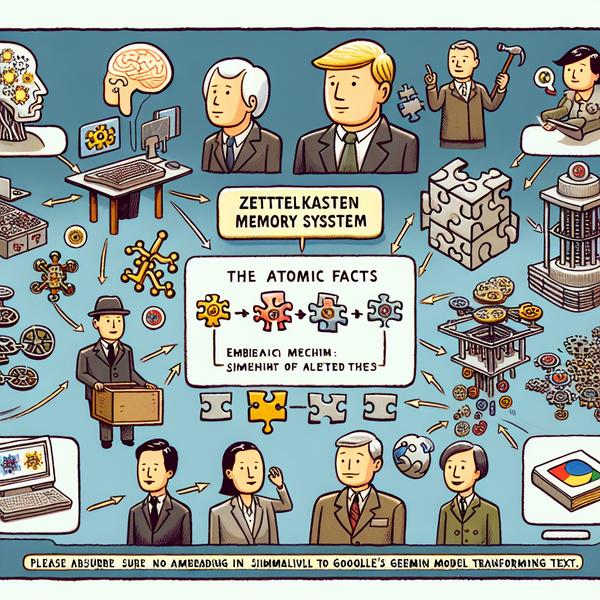
- The foundation of the Zettelkasten Memory System lies in atomic facts. Think of these like puzzle pieces, where each small piece contributes to a bigger picture. This approach mirrors how our brains break down and process information into smaller, understandable components.
- To manage these facts, the system utilizes Python libraries such as `networkx` for graphs and `scikit-learn` for similarity analysis. These tools allow the AI to group similar pieces of information into clusters, forming a network of related ideas.
- Another critical feature is its embedding mechanism powered by Google's Gemini model. This model transforms text into numerical vectors, enabling the assessment of semantic relationships between different nodes, just like comparing how “cat” is closer to “lion” than “car.”
- The system also runs a retry logic function called `retry_with_backoff`. It's designed to handle quota limit errors with patience, much like a courteous workaholic who avoids burnout by taking strategic breaks.
- All these components come together to make the foundation—an evolving graph populated by memories that interact with one another based on their semantic relationships.
Transforming User Input into Actionable Knowledge
- Imagine feeding a single thought or event, like "The sun is shining this morning," into the system. This input doesn’t remain as an idle sentence but is further broken down and analyzed.
- The `_atomize_input` function takes charge of dividing the text into atomic ideas. For example, it might split "We are building a solar energy dashboard" into "We are building a dashboard" and "Solar energy is the focus."
- Next, each small fact finds its place in the knowledge graph. The AI searches for relationships or overlaps within existing nodes using cosine similarity and links them accordingly.
- Suppose several nodes already discuss “solar energy.” The new idea might link to nodes about "weather dependence" or "panel efficiency" to form logical, data-driven threads of connection.
- This architecture mimics how we remember—a concept that creates neurological connections based on relevancy, ensuring ideas don't just float around unused.
Teaching an Agent to "Sleep" and Consolidate Insights
- This system doesn't stop at collecting facts—it goes further by consolidating knowledge much like how the brain processes memories during sleep. By running a special function, clusters of related thoughts are abstracted into higher-level insights.
- Imagine a group of connected ideas about turning sunlight into electricity. During consolidation, the AI creates an overarching insight such as, “Optimized designs improve renewable energy generation.”
- High-degree nodes (those with multiple connections) become centers for reflection. These nodes summarize dense clusters into simpler, broader conclusions.
- Just as REM sleep clears mental clutter and streamlines memories, the AI memory consolidation eliminates redundancy while making its knowledge graph more efficient.
- These insights are then added back into the graph with bright, distinct visual markers (e.g., pink nodes in the developed visualization).
Answering Complex Questions using Cross-Nodal Understanding
- The system isn’t just a memory dump—it actively performs reasoning. With a question like “What are the downsides of React for solar apps?” it uses embeddings to dive into related nodes and their connections.
- By scanning through direct matches and following paths like "React ➝ performance ➝ low-end devices," it uncovers evidence-based answers such as "React performance was suboptimal for low-end devices due to rendering inefficiencies."
- It doesn’t stop at surface-level responses. Related nodes might also discuss alternative solutions like "Switching to Svelte improves performance and satisfaction," creating a chain of reasoning.
- This contextual understanding shows pathways that mimic human reasoning when trying to cross-check knowledge while solving problems.
- Whether you're an engineer, writer, or researcher, this capability makes the system exceedingly versatile for both practical and creative tasks.
Visualizing Memory: A Glimpse into the Agent's Mind
- If you could peek into the mind of this AI, it would resemble an elegant web. Using tools like `pyvis` for visualization, the knowledge graph materializes as an interactive map where facts and insights are connected by meaningful lines.
- Think of brainstorming sessions on a whiteboard, where big ideas are circled and arrows connect related ideas. The visualization generates a real-time "living" diagram of the AI's thought process.
- For instance, a node labeled “Solar Panel Dashboard” could have edges connecting it to facts like "backend: Python" and "frontend: React." These connections are meaningful snippets of its evolving brain.
- This dynamic and colorful map can be exported into HTML, enabling humans to manipulate and explore the graph’s interactive layout for better insights.
- Not only is this graph visually appealing and informative, but it also doubles as a tool for developers to troubleshoot, optimize, and expand the AI’s memory structure effortlessly.
