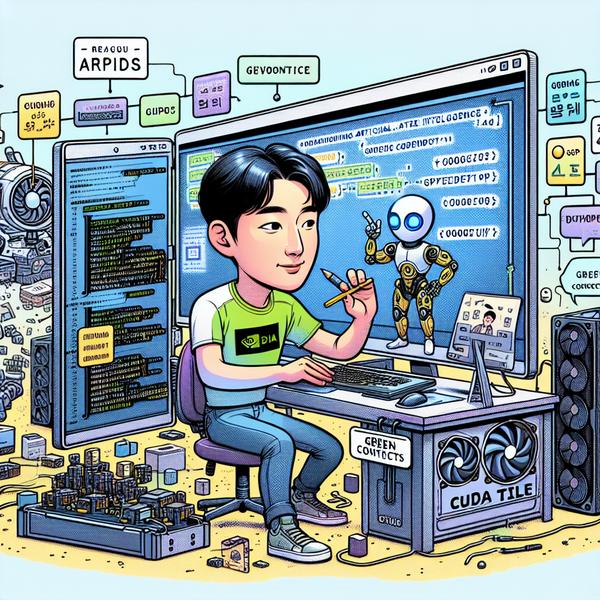
NVIDIA is revolutionizing the realm of Artificial Intelligence (AI) through groundbreaking innovations like CUDA Tile and "Green Contexts". These tools strive to simplify complex programming, providing developers with higher-level abstractions, boosting productivity, and ensuring that software evolves alongside rapidly developing hardware like GPUs. Spearheaded by Stephen Jones, a key architect of CUDA, NVIDIA’s advancements aim to empower developers worldwide while reducing the barriers of performance optimization. With a Python-first approach and robust developer tools, these innovations ensure developers can innovate efficiently and future-proof their applications, regardless of the programming language they prefer.
Advancing GPU Programming with CUDA Tile
- CUDA Tile redefines GPU programming by shifting away from the traditional thread-centric approach. Instead, it enables programmers to operate at a higher abstraction level, targeting arrays, tensors, and vector data directly.
- This approach simplifies code development and optimization. Think of it like replacing a building’s blueprint with an advanced 3D model—developers now see the bigger picture and make improvements more efficiently.
- Stephen Jones emphasizes how this approach supports the latest Tensor Cores, which are now denser than ever, to bridge the performance gap left by a slowing Moore’s Law.
- A futuristic aspect of CUDA Tile is its adaptability. Programs expressed through high-level operations like "Tensor A times Tensor B" are automatically optimized by the compiler for the current hardware platform, ensuring long-term usability.
- For example, a developer working with Ampere architecture today can migrate their programs seamlessly to future GPUs like Hopper or Blackwell, maintaining compatibility.
Python as the Lingua Franca of AI
- NVIDIA has embraced Python as the language of choice for introducing CUDA Tile due to its popularity and intuitive syntax. Python users, especially those who regularly use libraries like NumPy, will feel right at home.
- The launch of CUDA Tile for Python offers AI enthusiasts instant accessibility. Imagine giving a bicycle to someone who’s been walking—it immediately boosts their efficiency and understanding.
- That said, developers who rely on languages like C++ need not worry. Support for C++ will roll out next year to provide maximum flexibility.
- By putting Python programmers first, NVIDIA nurtures the global AI community, ensuring that tools are accessible to learners and experts alike, regardless of their experience level.
- This approach also encourages collaboration among teams using different programming languages, ultimately fostering broader advancements in AI research and practical applications.
Innovations Designed for Real-Time Performance
- One of the biggest challenges in deploying AI in production is managing latency, especially for Large Language Models. Enter NVIDIA’s "Green Contexts".
- Green Contexts enable developers to partition their GPU resources, much like dividing a pizza into slices for different eaters. Each slice can independently handle tasks like data pre-fill or output decoding without competing with others.
- Imagine running a video game on one half of your system while streaming video on the other without drops in quality. Green Contexts do exactly this for AI workloads within a single system environment.
- By addressing latency and resource competition, NVIDIA makes deploying AI models smoother and more predictable, qualities critical for industries like healthcare and autonomous driving.
- Companies using Green Contexts can also minimize hardware costs since multiple tasks can now run in harmony on a single unit, reducing the need to scale horizontally.
No Black Boxes: Empowering Developers Through Transparent Tools
- A frequent concern with high-level programming tools is losing control over the finer details—this is what students often grumble about when shifting from basic calculators to automated solutions.
- NVIDIA addresses this by sticking to its core philosophy: empowering developers with robust tools. Nsight Compute, for instance, lets developers inspect code down to individual machine-level instructions.
- It’s like peering into the engine of your car while driving it. You can check the fuel levels, temperature, and everything else while still accelerating smoothly on your journey.
- Jones, with his aerospace background, reiterates the importance of transparency, ensuring developers can debug, optimize, and retain mastery over their projects.
- This degree of control guarantees that while productivity enhancements drive progress, the hands-on expertise of developers remains critical to innovation.
From Concept to Market in Lightning Speed
- The ultimate goal of NVIDIA’s updates is to boost developer productivity. By "left-shifting" the performance curve, programmers can achieve 80% optimization in a mere week instead of several months.
- This philosophy acknowledges the reality of fast-paced industries where time-to-market can mean the difference between a project's success or failure.
- An analogy would be learning to swim in shallow water before diving into the ocean—most skills are quick to learn, and once mastered, diving deep becomes your choice.
- Even with these simplified tools, the path to achieving 100% hardware performance is available. Developers who want to squeeze maximum efficiency out of their applications can still push their hardware to its peak.
- These capabilities ensure that everyone, from beginners to seasoned professionals, can work at their own pace without feeling overwhelmed yet still be competitive.
Conclusion
NVIDIA’s CUDA updates mark a milestone in AI development, blending simplicity with sophistication. By introducing CUDA Tile, Python-first tools, and innovative features like Green Contexts, NVIDIA enables developers to work smarter, faster, and on a broader scale without sacrificing control or customization. Whether you're a Python enthusiast or a hardware expert, these advancements are designed to meet your needs and future-proof your work. Armed with transparent tools and a productivity-centered approach, AI professionals can confidently navigate an evolving landscape, delivering fast and powerful solutions to the challenges of tomorrow.
