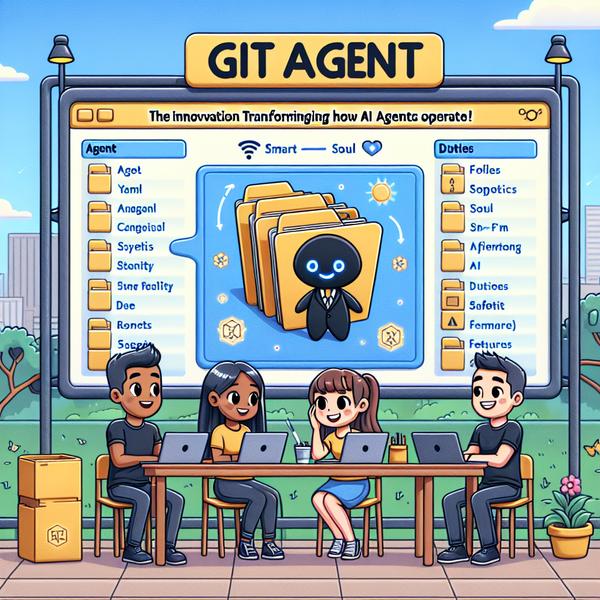
Current AI technology is evolving rapidly, but it still faces significant challenges, especially in standardizing frameworks. Developers often need to navigate different ecosystems like LangChain, AutoGen, or OpenAI Assistants, which can result in time-consuming rewrites and inefficiencies. Enter GitAgent, a solution transforming how AI agents operate by introducing a universal format. By utilizing a folder structure like Git, developers can better manage and deploy AI agents across different platforms while ensuring compliance and safety. This innovation aims to make AI accessible, scalable, and transparent for all.
The Backbone of GitAgent: Modular Components
- GitAgent operates on a smart folder-based system, housing key components like agents' structure and specifications. Imagine it as a recipe book where each folder contains specific role details.
- At the heart is the
agent.yaml, akin to a blueprint specifying models, dependencies, and much more. Without it, an agent would feel unfocused, like a ship without a compass. - The
SOUL.md, as poetic as it sounds, defines the agent’s personality. It’s like defining the personality traits of your favorite robot in a sci-fi movie. - Other files like
DUTIES.mdand folders likeskillsandtoolsexpand the agent’s arsenal, ensuring key capabilities are intact while safety features are baked in through therulesdirectory. - All of this modular design lets software developers focus on innovating rather than wasting time rewriting redundant code for every ecosystem shift.
Git As the Memory Keeper
- One standout feature is GitAgent’s memory architecture. Imagine taking a digital diary of every interaction—this is exactly what GitAgent achieves via its
memoryfolder. - Markdown files like
context.mdstore events, whiledailylog.mdacts like a daily activity log, making memory more accessible and auditable for developers. - Not only does this lend AI agents “recall,” but with Git, versioning tools allow developers to track changes effortlessly, like rewinding episodes from a favorite TV show.
- If memory quirks or inaccuracies emerge, developers can simply use the git revert functionality to shift back to a safer stable state.
- This change takes opaque databases and turns them into transparent, human-readable states, making debugging a breeze and compliance foolproof.
Seamless Workflow Interoperability
- GitAgent brings scripts to life by implementing CLI-driven workflows. Picture it as a universal translator for AI systems.
- With simple commands like
gitagent export -f [framework], developers can seamlessly integrate their agents into multiple platforms, be it OpenAI or AutoGen. - This flexibility ensures that developers avoid vendor lock-in, a common issue plaguing platforms today.
- Whether working with Claude Code’s terminal setups or LangChain’s graph-based logic system, exports work without breaking the underlying framework definitions—keeping the core logic intact.
- Overall, this modularity saves costs and reduces operational risks as developers are no longer tied to the intricacies of just one platform.
Regulatory Compliance with Duties.baked In
- Compliance is tricky in high-stakes fields like finance or healthcare, but GitAgent simplifies this through its Segregation of Duties (SOD) model.
- Developers can assign clear roles—like a maker to kick off tasks and a checker for final approvals—and programmatically enforce them through
DUTIES.md. - This structure ensures no single AI agent is granted excess control, preventing unauthorized actions like approving massive transactions single-handedly.
- Furthermore, commands like
gitagent validateact as a spell-checker for compliance, ensuring all matrix rules are followed before deployment. - This layered validation ensures that even in regulated spaces requiring precision, you can easily adapt GitAgent without legal risk exposure.
Closing the Gap Between AI and Developers
- GitAgent isn’t just about workflows; it’s a bridge between developers and cutting-edge technology. By standardizing processes, even startups can dive into AI with reduced entry barriers.
- The use of Markdown files for everything from memory to rules enables developers from all skill levels to tweak, modify, or control an AI agent’s journey.
- In the age of AI, where systems feel like black boxes, GitAgent provides a flashlight—making knowledge open-source and easily accessible.
- It allows teams to collaborate like never before by integrating Git branches and approval workflows into AI development tasks.
- Ultimately, GitAgent’s emphasis on openness, compliance, and universal compatibility transforms AI from intimidating to user-friendly.
