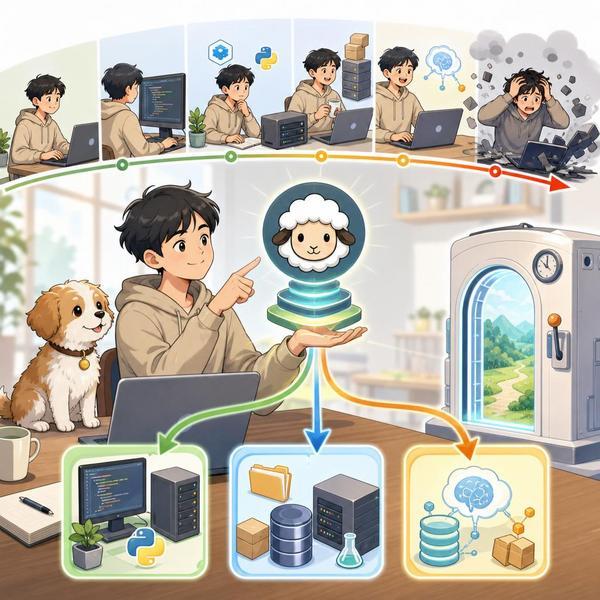
Shepherd is a new open-source Python runtime substrate that lets meta-agents fork, replay, and revert any agent run, which means teams can jump back to an earlier step instead of starting over after a mistake. It was introduced by researchers from Northeastern University and Stanford University to solve a big problem in long-running AI agent workflows, where files, servers, packages, and prompt cache keep changing in ways a simple chat log cannot fully save. Shepherd records each action as a Git-like typed event trace, restores live process and filesystem state together, reports 5× faster forks than Docker, and reaches over 95% prompt-cache reuse on replay. In early alpha today, it already shows strong results for coding agents, meta-agents, supervision, replay, rollback, and reinforcement learning, making it one of the most interesting new releases in agentic AI and open-source AI infrastructure.
Why Shepherd Solves a Real Home Problem for Long Agent Runs
- Many AI agents look smart at the start, but the real trouble begins when they work for a long time and keep changing their environment.
- By step ten or step twenty, the agent may have edited code files, started a local server, installed libraries, created test data, and built a useful prompt cache in memory.
- If the agent makes one bad choice at that point, the damage is bigger than a wrong answer in a chat window.
- It is more like a student doing homework for two hours, then erasing the correct page because they misunderstood one teacher comment.
- That is the pain Shepherd tries to fix.
- Most current tools give teams only two weak choices after a mistake.
- The first choice is to keep moving forward and patch the damage.
- This can work, but it often makes the context longer, the prompt heavier, and the token cost higher.
- The second choice is to restart from the beginning.
- That sounds clean, but it is expensive and slow because the team must pay again for model calls, tool calls, setup steps, and test runs.
- Even worse, AI runs are not perfectly repeatable, so a restart may not rebuild the exact same state.
- You may begin with the same goal and still end in a different place.
- That makes debugging much harder.
- Shepherd gives a third choice that feels much more natural.
- Instead of patching forward or throwing everything away, engineers can go back to an earlier point, fork from there, and try again.
- This is similar to returning to a save point in a video game after taking a wrong turn.
- You do not replay the full game from the first minute.
- You load the right moment and continue with better decisions.
- That simple idea is powerful for coding agents, research agents, and DevOps systems.
- The word Home appears on the source website, and it fits here in a useful way.
- For many developers, a working agent environment becomes a kind of temporary home.
- It has familiar files, prepared tools, running services, and a known setup.
- When an error forces a full restart, it feels like losing that home and having to rebuild the room from scratch.
- Shepherd makes it easier to return to a safe version of that home instead of rebuilding every wall again.
- This matters most in jobs where agent failure is expensive.
- Examples include software engineering, data engineering, quantitative research, security testing, and AI platform development.
- In these areas, one failed run can waste real money and real time.
- A coding agent might spend thirty minutes setting up dependencies only to break a correct file near the end.
- Without a good rewind system, that lost time piles up fast across a team.
- So even though Shepherd sounds technical, the core idea is easy to understand.
- It helps people avoid losing useful work when an AI agent makes a bad move.
- That is a very human problem, and it is why this project is getting attention in AI agents, open source, and tech news circles.
How the Open Source Trace Works Like a Time Machine
- Shepherd is described as an Open Source Python substrate, and that label matters because it tells developers they can inspect, test, and build on the system themselves.
- But the more exciting part is how it records an agent run.
- Instead of treating the run as a fuzzy history, Shepherd turns it into a structured trace made of typed events.
- Each event captures an interaction between the agent and its environment.
- That means the run becomes something solid and replayable, not just a memory of what happened.
- A simple way to picture this is to imagine a cooking show where every action is written down with perfect detail.
- Not just “made soup,” but “cut onions,” “heated pan,” “added oil,” “turned heat low,” and “tasted at minute seven.”
- If the dish goes wrong, you can return to the exact step before the mistake and try another move.
- That is close to what Shepherd does for agents.
- The project compares its system to Git, but it goes beyond ordinary version control.
- Git is great for files, yet it does not fully preserve the live state of a running process or a warm prompt cache.
- Shepherd aims to save both the process state and the filesystem together using copy-on-write behavior.
- Because of that, a past moment in the run becomes more like a living snapshot than a dead folder copy.
- When developers fork from that point, they continue from a real working state.
- This is what makes replay and revert far more practical.
- The source material explains four core ideas inside Shepherd.
- They are tasks, effects, runs, and workspaces.
- A task is like a contract that says what the model is supposed to do.
- An effect is what happens when the task reaches outside itself, such as reading a file, calling a tool, or asking for something from the environment.
- A run is the durable record of these crossings.
- A workspace is the area where the agent can act.
- These concepts may sound abstract at first, but they are useful because they make the run easier to watch and control.
- Think of a school science experiment.
- If students write down the method, ingredients, tools, and observations, the teacher can see exactly where the experiment changed.
- That lets the class repeat only the important part instead of restarting the whole lesson.
- Shepherd brings that same kind of order to AI runtime behavior.
- The research team also notes that core operations are formalized and mechanized in Lean.
- For non-experts, the important point is that the team is not only building a clever system but also trying to define its behavior very carefully.
- That increases trust, especially when meta-agents may supervise or alter other agents.
- Another key feature is its reported replay efficiency.
- Because the prompt prefix up to the branch point stays the same, Shepherd can reuse prompt cache during replay.
- The paper reports more than 95% prompt-cache reuse.
- That is a big deal because prompt reuse can cut cost and speed up repeated work.
- Imagine studying for a test and being allowed to keep all the notes you already memorized except for the last wrong answer.
- You only redo the small broken part, not the whole chapter.
- That is the practical value behind Shepherd’s trace design.
AI Agents, Tutorials, and the Simple Python Setup Teams Can Try
- The source article places Shepherd near categories like AI Agents and Tutorials, and that makes sense because this is the kind of tool engineers will want to test in hands-on workflows.
- Right now, Shepherd is available in early alpha, so it is not ready for full production use.
- Still, it is deployable enough for careful experiments, prototypes, and research builds.
- It is MIT licensed, which is friendly for developers and companies who want room to explore.
- The setup requirement is also clear.
- You need Python 3.11 or newer.
- The package can be installed from PyPI with the following command:
pip install shepherd-ai- That one line is small, but it opens the door to a very different way of managing agent runtime state.
- For operating system level permission enforcement, the article says macOS uses Seatbelt and Linux uses Landlock inside a privileged container.
- That tells us Shepherd is not only about convenience.
- It also cares about control over what the agent may touch.
- Permissions are declared in the signature, which means access rules are planned as part of the task itself.
- This is a strong idea because it makes safety less accidental.
- Instead of hoping the agent behaves well, the system can define limits up front.
- A simple example helps here.
- Suppose a coding agent needs to read from a Git repository but should not edit sensitive files outside that project.
- With permission-aware runtime structure, the team can narrow the writable area the way a teacher might allow a student to use only certain lab tools during an experiment.
- That reduces risk and makes supervision easier.
- From an SEO and reader point of view, many people searching for Shepherd will want practical answers.
- Can I install it.
- Can I test it.
- Is it open source.
- Does it fit Python workflows.
- The answer to all of these is basically yes, with the warning that it is still early.
- For developers who enjoy trying fresh tools before they become mainstream, this is often the sweet spot.
- You get to understand the system while the community is still shaping best practices.
- If you were building a tutorial around Shepherd, a beginner-friendly path might look like this:
- First, create a simple coding task where an agent edits a file and runs a test.
- Second, record the run and inspect the events.
- Third, force a bad action, such as changing a correct line into a broken one.
- Fourth, fork from the earlier step and replay the remaining actions.
- That kind of exercise would show more clearly than a long theory page why Shepherd matters.
- It turns rollback into something visible and teachable.
- For students and new engineers, that makes the concept much easier to grasp.
- Instead of hearing “typed event trace,” they can see a real run go wrong, roll back, and recover.
- That is when the value becomes obvious.
From Voice to Robotics: Where Meta-Agent Supervision Becomes Useful
- The source website menu also includes words like Voice AI and Robotics, and those terms help us think about where Shepherd-style control could matter beyond coding alone.
- The article focuses mainly on coding and system agents, but the bigger idea is about long-horizon tasks in changing environments.
- Any agent that keeps state over time can benefit from better rewind and replay tools.
- That includes assistants that speak, act, observe, and make repeated decisions.
- Take Voice AI as an example.
- Imagine a customer service agent that handles a long technical call.
- It may open account data, follow policy steps, remember earlier user details, and trigger backend actions.
- If it makes one wrong tool call halfway through, a simple chat transcript is not enough to fix the full situation.
- A forkable runtime could let a supervisor return to the safe point before the wrong action and try a different branch.
- Now think about robotics.
- A robot helper in a warehouse may scan shelves, move items, update inventory, and respond to sensor input.
- If it chooses the wrong route or changes the wrong internal plan, engineers often want to inspect the state just before the error.
- A replayable trace can support that kind of debugging much better than a plain log.
- It is like being able to pause a sports match, rewind to the pass before the mistake, and ask what should happen differently.
- The article’s strongest point in this area is the role of the meta-agent.
- Once a run is forkable, another higher-level agent can watch and intervene.
- That means one agent works, while another agent acts like a coach, referee, or safety helper.
- If the worker agent is about to commit a bad write, the supervisor can step in before the damage spreads.
- This is a very practical pattern.
- In real life, many jobs use a second set of eyes for risky steps.
- A trainee surgeon has a senior doctor nearby.
- A student driver has an instructor with a brake pedal.
- A junior developer has a code reviewer.
- Shepherd gives AI systems a way to support that same layered oversight.
- The CooperBench result in the article is especially eye-catching.
- A live supervisor raised pair-coding pass rates from 28.8% to 54.7%.
- That is not a tiny gain.
- It suggests that intervention at the right moment can make agents much more useful in practice.
- There are also gains in counterfactual meta-optimization, where branching exploration beat baselines by up to eleven points and reduced wall-clock time by up to 58%.
- That means teams can compare different strategy branches side by side, rather than betting everything on a single line of action.
- In reinforcement learning too, forking rollouts at selected turns improved TerminalBench-2 from 34.2% to 39.4%.
- These results matter because they show Shepherd is not only a storage trick.
- It changes how agents can be supervised, trained, and improved.
- Over time, this could influence many application areas where action history and state recovery matter just as much as raw model intelligence.
Newsletter Signals, Performance Numbers, and What to Watch Next
- The source website also highlights a Newsletter, and that word is a nice reminder that fast-moving AI tools need ongoing attention.
- Shepherd is early alpha, so the story is not finished.
- Still, the early numbers are strong enough to make it worth watching closely.
- The project reports forks that are 5× faster than Docker.
- For teams used to heavy container workflows, that is a meaningful speed claim.
- If true in broader real-world settings, it could reduce waiting time whenever operators need to test alternate paths.
- The over 95% prompt-cache reuse result is just as important.
- Model usage cost often grows quietly in the background of agent systems.
- Anything that reuses already-known prompt history without repeating the full expense can improve both speed and budget.
- A helpful picture is to think about climbing a mountain trail.
- If you slip near the top, you do not want to be sent back to the parking lot every time.
- You want to go back to the last safe checkpoint and continue from there.
- That is what good runtime replay feels like.
- There are, however, healthy limits to remember.
- Early alpha software may change fast.
- Features may move, rough edges may appear, and production hardening may take time.
- Companies should not read exciting benchmark numbers and blindly rush into critical deployment.
- A smarter approach is to evaluate Shepherd in contained experiments.
- Try a local coding workflow.
- Measure rollback usefulness.
- Compare replay cost against your current system.
- Then decide where it brings real value.
- The listed industry fit from the article gives a good map.
- Software engineering, DevOps, AI infrastructure vendors, finance research, security tooling, and data engineering all share one thing.
- They run agents in expensive environments where a mistake late in the process hurts more than a mistake at the start.
- That is exactly where Shepherd may shine.
- It is not trying to replace every runtime.
- It is trying to become the right substrate for state-heavy, long-horizon agent work.
- That focus is smart.
- Another detail worth watching is how the ecosystem grows around the main project.
- The article points to a paper, a GitHub repository, an experiments repository, a project page, and a PyPI package.
- That gives interested readers several paths to explore.
- Researchers may read the paper first.
- Builders may open the GitHub repo.
- Experimenters may try the install command and run small tests.
- As more examples appear, Shepherd could become easier for the wider open-source community to understand.
- Right now, its big promise is simple.
- Let agents make progress without making every late mistake painfully expensive.
- If the team can keep improving usability, documentation, and production readiness, Shepherd may become one of the more important infrastructure ideas in the next wave of agentic AI.
Conclusion
Shepherd introduces a practical new way to manage long-running AI agent workflows by letting teams fork, replay, and revert runs instead of restarting from zero. Its main strength is that it saves live state, not only files, which makes rollback more useful for coding agents, meta-agents, and other state-heavy systems. The early results, including faster-than-Docker forks, high prompt-cache reuse, and better benchmark outcomes under supervision, suggest real promise even though the project is still in early alpha. For developers, researchers, and AI infrastructure teams, Shepherd is worth watching because it turns agent recovery from a painful reset into something much closer to a smart checkpoint system.
