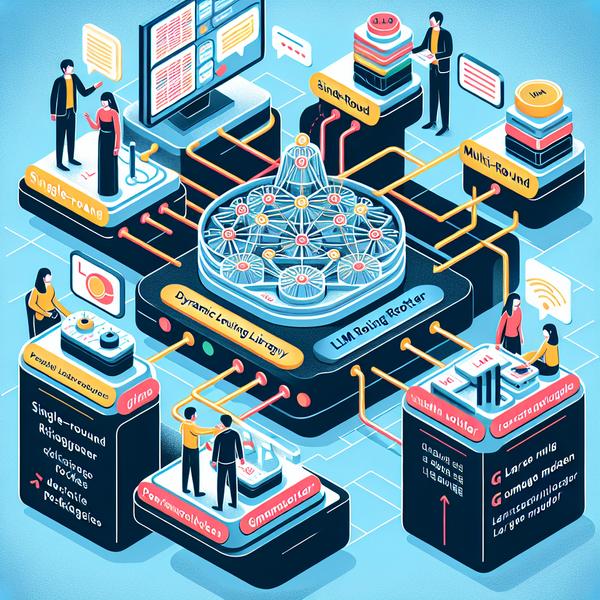
LLMRouter is a revolutionary system emerging from the University of Illinois Urbana-Champaign, built to address the challenge of choosing the best large language model (LLM) for any given task. Operating as a dynamic routing library, it decides which model best answers a query based on task complexity, cost efficiency, and performance quality. The platform offers seamless integration with over 16 routing models, a streamlined data pipeline, and interactive tools for personalized or multi-step reasoning workflows. Whether you’re an AI enthusiast or a professional, this open-source tool promises to optimize how we use large models in practical, cost-conscious ways.
Understanding the Four Router Families
- LLMRouter organizes its algorithms into four unique families. Each group is specifically designed for a variety of situations, making it like a toolbox with tools for every type of task.
- Single-Round Routers, such as "knnrouter" or "mlprouter," are like express packages—they make one quick routing decision based on models like k-nearest neighbors or machine learning techniques.
- For more complex needs, Multi-Round Routers shine. Imagine a decision-maker taking multiple steps to solve a puzzle. "Router R1" even uses reinforcement learning for decisions, balancing costs and results.
- When it comes to personalization, GMTRouter excels. It's like having a smart assistant that remembers past preferences to better serve individual users using graph-based understanding.
- If tasks involve reasoning in layers, Agentic Routers, such as "knnmultiroundrouter," are the stars. These are ideal for dynamically navigating through multi-step processes just by changing single configurations.
The End-to-End Data Generation Pipeline
- LLMRouter’s data pipeline simplifies the difficult task of preparing and testing models. Think of it like a well-organized workshop where raw materials are processed into useful tools.
- With three key stages—data extraction, embedding generation, and API-based evaluations—it ensures that no step is overlooked. The generated JSON and routing data are intuitive for engineers.
- This system supports benchmarks like Trivia QA or HumanEval. A good example is extracting quiz questions and pairing them with suitable model predictions.
- Empowering engineers is easy since YAML-based configurations allow datasets to be changed or expanded without needing to modify any backend code.
- Developers who’ve been overwhelmed by tedious data handling will find the pipeline’s structure helpful for both speed and reliability.
Maximizing User Experience with the Chat Interface
- Imagine the convenience of chatting with a highly skilled assistant. LLMRouter makes this a reality with its user-friendly Gradio-based chat front-end.
- Choose between different query modes: "current_only" for single messages, "full_context" for historical dialogue stitched together, or "retrieval" for enriched queries.
- The interface feels interactive and even visualizes how models make decisions in real-time. It’s like watching a chef prepare your meal in front of you.
- This transparency allows users to trust the system and tweak configurations if needed, making it versatile for both learnings and professional use.
Customizing the System with Plugin Support
- If you love building things your own way, LLMRouter’s plugin system is a game-changer. New ideas can easily be implemented as custom routers.
- From random selections via "randomrouter" to difficulty estimations with "thresholdrouter," the possibilities are endless for creative problem-solvers.
- The plugins are stored systematically and automatically discovered, even including your local directories! Installation feels like snapping together LEGO blocks.
- For teams, this extensibility means innovation without breaking existing tools. It’s a dream setup for experimentation!
Key Takeaways and Benefits of LLMRouter
- Think of LLMRouter as the traffic controller of AI, efficiently guiding “queries” to the right model while saving time and money.
- Its array of routing algorithms, from graph-based personalization to multi-round decision-making, ensures there’s something for every context.
- The entire framework—from pipelines to APIs—makes it user-friendly without compromising depth. Engineers and researchers alike gain performance insights faster.
- AI projects now have a reliable, extendable foundation. From turning tricky tasks into manageable workflows to creating robust systems, the opportunities are boundless.
