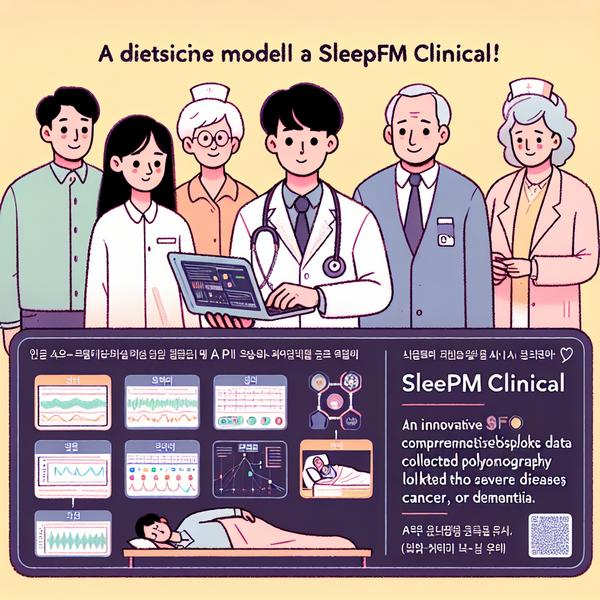
Stanford Medicine researchers have developed an innovative AI model called SleepFM Clinical. This advanced multimodal foundation model analyzes polysomnography—or sleep study data—unlocking the ability to predict over 130 diseases, including dementia and heart failure, from just one night of sleep recordings. Published in Nature Medicine, this groundbreaking research uses data from 65,000 participants and 585,000 hours of sleep records. The project even offers open-source code to promote advancements in medical research. With such cutting-edge contributions, AI is proving to be a game-changer in healthcare by making complex disease prediction more accessible.
Turning Sleep Data into a Powerful Health Predictor
- SleepFM’s abilities revolve around something most of us take for granted—our sleep. The model analyzes polysomnography, which tracks your brainwaves, heart rate, and even your breathing patterns during your sleep.
- This is like a health detective examining every detail from your resting hours. It doesn’t just see how well you slept but finds patterns linked to diseases as severe as stroke or cancer.
- Imagine a single night’s data telling you not just about potential sleep apnea but also chronic conditions developing silently in your body—sounds almost magical, right? That’s SleepFM in action, making this process an incredible leap forward.
- Anyone who has visited a sleep lab will know how comprehensive polysomnography tests are. Millions still only use them for sleep staging or diagnosing apnea, but with an AI like SleepFM, their value skyrockets!
- This means patients may receive early intervention with more confidence, reducing the burdens of late diagnoses or trials of advanced illnesses.
The Brainpower Behind SleepFM’s Success
- How does SleepFM Clinical handle so much information? It all comes down to its smart learning framework. Picture this: the model treats each channel of polysomnography—brain activity to respiratory changes—as a piece of a puzzle.
- By analyzing shared representations across these puzzle pieces, SleepFM builds a big, clear health picture! And yes, it’s as complex as it sounds but also brilliantly effective.
- Using nearly 25 years of sleep data from the Stanford Sleep Medicine Center, SleepFM has already been honed with tried-and-tested clinical data. Whether identifying disease onset risks or mapping long-term survival, the results speak volumes.
- Adding to its power, the inclusion of diverse demographic factors like age and sex ensures a comprehensive, individualized analysis tailored to different people.
- This is like giving the model a roadmap to predicting a host of medical events—making it faster, smarter, and way more reliable for real-world medical use.
Unmatched Precision in Disease Prediction
- So, how accurate is SleepFM Clinical? Well, it doesn’t just perform—it outperforms many traditional models used for similar tasks.
- Let’s break that down. SleepFM identified 130 disease outcomes with impressive precision, including heart failure and psychiatric disorders, even years before typical modern tools.
- Here’s an example: stroke and atrial fibrillation predictions from SleepFM rival existing scores that doctors heavily rely on. Isn’t that jaw-dropping?
- Its benchmarks for sleep studies also outperform manual or semi-automated tools widely accepted. Whether it’s macro-AUROC measurements or time-to-event modeling, the AI genuinely pushes boundaries.
- With such robust validation, hospitals worldwide might soon adopt such AI-driven methods for routine care. This could save countless lives just by timely detection using existing healthcare data systems!
The Edge Over End-to-End Models
- A standout feature of SleepFM is how it excels where end-to-end deep learning models may lag. While others need task-specific configurations, SleepFM sees the bigger picture.
- Think about it as a teacher who doesn’t just memorize set answers but understands the entire exam syllabus like the back of their hand. SleepFM makes predictions by abstracting general sleep representations instead of fitting an outcome based on only labeled datasets.
- Also important? Simpler survival heads paired with its well-pretrained backbone mean researchers can achieve high performance with fewer labeled data pools—talk about resource efficiency!
- Healthcare providers using SleepFM could save costs on extensive sample collecting without cutting corners technologically.
- Furthermore, smaller clinics unable to afford bespoke technical expertise could find lifesaving use cases implemented seamlessly thanks to this pretrained, flexible setup.
Open Source Code Fosters Global Healthcare Innovation
- One of the most exciting parts about this research is Stanford’s decision to make SleepFM’s code open source on GitHub. This isn’t just a technological marvel confined to one institution—it’s meant to empower global research communities.
- Any developer, researcher, or health organization can study this model and adapt variations for their unique needs—whether tackling regional diseases or specific demographic nuances.
- Think about the collaborative projects made possible! A university in a developing country could use SleepFM to identify diseases commonly affecting its population, without building such an advanced tool from scratch.
- This accessibility creates a culture of shared innovation rather than closed walls, which in turn accelerates advancements in machine learning applications worldwide.
- It’s as if Stanford flipped the switch on transforming AI-powered clinical analytics from exclusive tools into universally shared resources—a tremendous source of positive disruptions.
